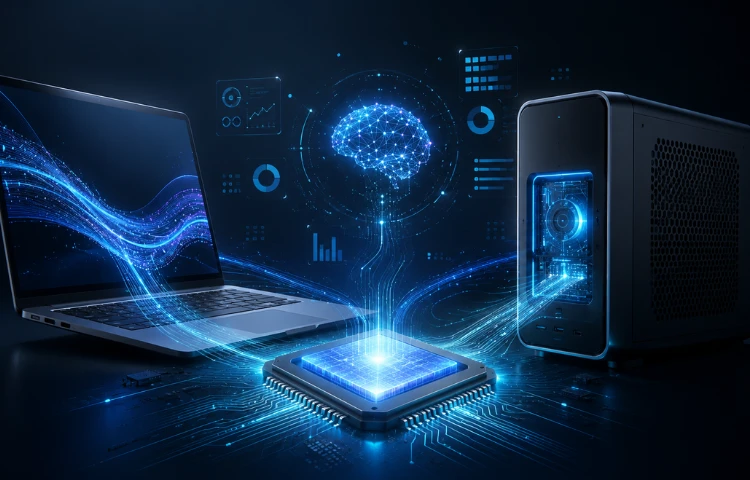
The next big leap in personal computing isn’t just about thinner laptops, sharper screens, or longer battery life. It’s about giving everyday devices the kind of AI power that once belonged only in massive data centers. With the rise of new AI superchips, laptops and desktop PCs are being redesigned to run smarter, faster, and more independently—right from your desk, backpack, or home office.
This shift marks a major turning point for the AI PC era. Instead of sending every AI task to the cloud, future computers could run advanced assistants, creative tools, coding support, data analysis, and productivity workflows directly on the device. That means faster responses, stronger privacy, and a more seamless experience for professionals, creators, developers, and everyday users.
The AI PC just got a serious power-up
Nvidia has officially pushed the AI PC race into a new gear with the launch of RTX Spark, a “superchip” designed to bring advanced artificial intelligence directly into laptops and desktop PCs. Instead of relying heavily on cloud servers for demanding AI tasks, RTX Spark aims to let users run powerful AI models locally on their own machines, making the everyday PC feel less like a passive tool and more like an intelligent teammate. Nvidia announced RTX Spark at Computex 2026 in partnership with Microsoft and MediaTek, positioning it as a new foundation for Windows PCs built around personal AI agents. [NVIDIA Newsroom]
That phrase, “personal AI computer,” is doing a lot of work here. The idea is not simply faster laptops. It is a shift toward computers that can understand natural language, manage tasks, automate workflows, generate media, help developers prototype applications, and run AI assistants with less dependence on external cloud infrastructure. In other words: your laptop may soon stop waiting for instructions and start helping you finish the work.
What is Nvidia RTX Spark?
RTX Spark is a new AI-focused computing platform that combines a powerful Arm-based CPU, Nvidia Blackwell GPU technology, unified memory, and Nvidia’s existing AI software ecosystem. According to reports from Tom’s Hardware, the platform includes a 20-core Arm CPU, a Blackwell GPU with 6,144 CUDA cores, and up to 128GB of LPDDR5X unified memory, connected through Nvidia’s high-speed NVLink-C2C architecture. [Tom’s Hardware]
That matters because AI workloads are memory-hungry. Running large language models, image generation tools, video editing assistants, code copilots, and agentic workflows on-device requires not only raw compute power but also fast access to large pools of memory. Nvidia says similar Grace Blackwell-based systems can deliver up to 1 petaFLOP of AI performance at FP4 precision, and its DGX Spark platform is designed to run AI development workloads with models up to 200 billion parameters.
Put simply: Nvidia is trying to shrink workstation-class AI capability into machines that fit on a desk—or even into a slim laptop bag.
Why this is a big deal for laptops and PCs
The traditional PC has mostly been a productivity machine: open apps, type documents, browse the web, edit files, repeat until coffee runs out. RTX Spark points toward a more agent-driven model, where the computer can execute multi-step tasks using AI. Nvidia describes this as moving the PC “from tool to teammate,” especially for AI agents, creative work, and gaming.
For professionals, that could mean asking a local AI assistant to summarize project files, generate code, analyze spreadsheets, create presentation drafts, or search through internal documents without uploading sensitive data to a third-party cloud. For creators, it could mean faster video editing, generative design, image workflows, and real-time rendering. For developers, it opens the door to testing and fine-tuning models locally before deploying them to cloud or enterprise environments.
The privacy angle is especially important. Cloud AI is powerful, but many organizations hesitate to send confidential business data, legal documents, medical records, design files, or source code to external servers. A local AI PC does not eliminate all security risks, but it can reduce unnecessary data movement and give users more control over where computation happens.
What RTX Spark means for businesses
For businesses, RTX Spark could reshape procurement decisions. Until recently, serious AI work often meant renting cloud GPUs, buying expensive workstations, or waiting in the eternal queue known as “IT budget approval.” AI-powered PCs create a middle path: local machines capable of running meaningful AI workloads while still fitting into familiar laptop and desktop environments.
This could be valuable for software teams, marketing departments, financial analysts, architects, researchers, and media studios. A marketing team, for example, could use local AI to generate campaign concepts, analyze customer feedback, create design drafts, and summarize research without constantly bouncing between cloud tools. A software team could prototype AI features locally, test models, and debug faster. A legal or compliance team could analyze sensitive documents with better control over data location.
However, businesses should avoid treating AI PCs as magic boxes. They will still need governance policies, access controls, model management, audit trails, and employee training. The hardware makes local AI more practical, but responsible implementation will decide whether it becomes a productivity win or another shiny gadget collecting dust beside the office printer.
The ethical and regulatory angle
More local AI power also raises important questions. If AI agents can act on behalf of users, companies must define what these agents are allowed to do, what data they can access, and when human approval is required. Microsoft and Nvidia are emphasizing new security layers and user control for agentic AI experiences, but organizations will still need clear internal policies. [IT Pro]
There is also an energy and sustainability conversation. Moving AI workloads from centralized data centers to millions of personal devices may reduce some cloud dependence, but it does not make computation free. A recent research paper on GB10-based edge AI hardware argues that better energy observability is needed for agentic AI systems, particularly when workflows involve multi-step orchestration and repeated tool use.
That means the future AI PC should not only be fast. It should also be measurable, efficient, transparent, and secure.
Will RTX Spark replace today’s laptops?
Not overnight. RTX Spark-powered machines are expected to appear first in premium laptops and compact desktops from major manufacturers such as Dell, HP, Lenovo, Asus, MSI, and Microsoft Surface. Early systems will likely appeal most to developers, creators, AI professionals, researchers, and high-end business users.
But the direction is clear. Just as GPUs transformed gaming, video editing, and machine learning, AI-focused superchips could redefine what people expect from everyday computers. The next wave of PCs will not simply open apps faster. They will understand tasks, run models locally, protect sensitive workflows, and assist users across work, creativity, and communication.
Final takeaway
Nvidia’s RTX Spark superchip is more than another processor announcement. It signals a major shift in personal computing: from cloud-dependent AI tools to powerful, local AI experiences built directly into laptops and PCs. For professionals and businesses, this could mean faster workflows, better privacy, richer creative tools, and more practical AI experimentation. For everyday users, it could make computers feel more natural, conversational, and proactive.
The AI PC era has been hyped for a while. With RTX Spark, Nvidia is giving that hype some very real silicon.