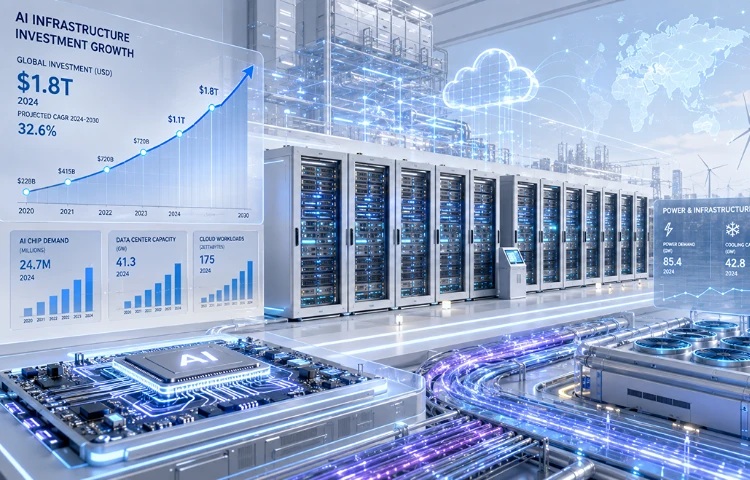
The artificial intelligence boom is entering a new—and considerably more expensive—phase.
For the past several years, technology companies have talked about AI models, intelligent assistants, automation, and enterprise productivity. Now, those ambitions are being translated into physical infrastructure: data centers, specialized processors, networking equipment, cooling systems, power contracts, and enormous cloud-computing clusters.
This is why Big Tech AI spending has become one of the most important stories in the technology sector. The question is no longer whether major technology companies believe in AI. Their capital budgets have already answered that.
The real question is whether earnings can prove that the investment is producing sustainable financial returns.
As a recent [Barron’s] explains, investors are becoming less willing to reward spending announcements on enthusiasm alone. They increasingly want evidence that higher capital expenditures are generating faster cloud growth, stronger customer demand, improved productivity, and eventually higher profits.
Why AI Spending Is Accelerating Now
Several factors are pushing spending higher at the same time.
First, demand for AI computing remains difficult to satisfy. Enterprises are deploying AI for software development, customer service, document processing, cybersecurity, marketing, logistics, forecasting, and research. Each new application creates additional demand for model training and inference—the process of running a trained model to generate an answer or complete a task.
Second, advanced AI systems require increasingly sophisticated infrastructure. The processors receive most of the attention, but a functioning AI data center also needs high-bandwidth memory, storage, optical networking, cooling equipment, backup power, and fast connections between thousands of machines.
Third, companies are trying to secure capacity before their competitors do. Data centers can take years to design, approve, connect to the electrical grid, and complete. A company that waits for demand to become obvious may discover that land, power, equipment, and skilled labor are no longer readily available.
Finally, infrastructure shortages can limit revenue. When cloud providers do not have enough computing capacity, they cannot serve every customer that wants to train or deploy an AI system. That turns capital spending into a growth requirement rather than an optional experiment.
In other words, the spending race is partly defensive. No leading technology platform wants to tell customers, “The AI revolution looks exciting, but we ran out of servers.”
Earnings Are Becoming AI’s Financial Audit
Upcoming earnings reports will function as a financial audit of the AI boom.
Investors will be listening for more than mentions of new models, assistants, or product features. They will be looking for measurable evidence that AI infrastructure is translating into revenue and cash flow.
Four indicators will matter most.
1. Cloud and AI Revenue Growth
The clearest positive signal would be accelerating revenue from cloud infrastructure, AI APIs, enterprise subscriptions, advertising systems, and intelligent business tools.
Strong demand demonstrates that the infrastructure is being used rather than simply constructed. It also indicates that customers are moving beyond small experiments and placing AI into production environments.
The key distinction is between interest and consumption. Thousands of companies can test an AI service without generating enough usage to justify hundreds of billions of dollars in infrastructure. Earnings must show that experiments are becoming recurring workloads.
2. Capacity Utilization
Management teams are likely to continue describing AI capacity as constrained. Investors should examine whether those constraints reflect healthy customer demand or operational bottlenecks.
High utilization is encouraging because it means expensive processors and facilities are producing revenue. Low utilization would be more concerning, especially as newly completed data centers begin adding depreciation and operating expenses.
Backlogs, customer commitments, contract duration, and cloud-capacity reservations can help reveal how much future demand has already been secured.
3. Operating Margins and Free Cash Flow
AI services can generate attractive revenue while still putting pressure on company finances.
Capital spending reduces free cash flow, while new infrastructure adds electricity, maintenance, staffing, and depreciation expenses. Even highly profitable companies can experience tighter cash generation when capital expenditures rise faster than operating income.
This creates a difficult balancing act. Management teams must invest aggressively enough to capture demand without building so far ahead of customers that returns deteriorate.
Investors should therefore compare AI-related revenue growth with capital intensity. A 30% increase in AI revenue sounds impressive, but it becomes less convincing when the infrastructure required to produce it grows by 70%.
4. The Useful Life of AI Hardware
Depreciation assumptions deserve more attention than they usually receive.
AI processors can remain physically functional for years, but newer generations may offer significantly better performance, energy efficiency, or cost per task. If hardware becomes economically outdated sooner than expected, companies may need to replace equipment faster or revise depreciation schedules.
A shorter useful life increases annual expenses and reduces the return generated by each infrastructure investment. Earnings calls may not provide a perfect answer, but comments about hardware refresh cycles, custom chips, efficiency, and depreciation will reveal how management teams are thinking about this risk.
The Spending Boom Extends Far Beyond Technology Companies
Big Tech AI spending is creating ripple effects across the broader economy.
Semiconductor manufacturers benefit from demand for advanced processors and memory. Networking companies supply the equipment connecting enormous computing clusters. Construction firms build specialized facilities. Utilities and power producers are being asked to support large, continuous loads. Cooling companies, electrical-equipment suppliers, fiber providers, and data-center operators are also becoming essential participants in the AI ecosystem.
This creates opportunities, but it also creates bottlenecks.
A delay in power-grid access can prevent a completed data center from becoming operational. A shortage of memory components can increase server costs. Restrictions on chip availability can alter construction plans. Local opposition can slow permitting. Water availability may also become a concern in regions where evaporative cooling is widely used.
The AI race is therefore becoming as much an infrastructure-management challenge as a software challenge.
Energy Is Emerging as a Strategic Constraint
Electricity may ultimately determine how quickly AI infrastructure can expand.
The International Energy Agency projects that global data-center electricity consumption could roughly double to around 945 terawatt-hours by 2030, with AI serving as the most important driver of the increase. Accelerated servers—the systems commonly used for AI workloads—are expected to account for a significant share of new electricity demand.
That forecast has major implications.
Technology companies will need to secure long-term energy supplies, improve computing efficiency, and place facilities in regions with sufficient grid capacity. Governments and regulators will need to consider transmission infrastructure, generation capacity, environmental standards, water usage, and the effect of large data centers on local electricity prices.
Sustainability is no longer a side topic in AI strategy. It is becoming a requirement for scalability.
The companies that generate more AI output from each unit of electricity may gain a meaningful economic advantage. Efficiency improvements in processors, cooling, model architecture, and workload scheduling could therefore become just as important as raw computing capacity.
What This Means for Business Leaders
Enterprise leaders should not interpret massive infrastructure spending as proof that every AI project will create value.
The buildout makes AI services more available, but customers still need disciplined implementation strategies. Businesses should focus on use cases with measurable outcomes, such as reducing processing time, increasing employee productivity, improving customer-service resolution rates, accelerating software delivery, or lowering operational costs.
They should also avoid becoming dependent on a single model or provider. AI pricing, performance, and product availability can change quickly. Flexible architectures make it easier to compare providers, adopt more efficient models, and control long-term costs.
Governance should grow alongside adoption. Organizations need clear policies covering data privacy, model accuracy, human oversight, cybersecurity, intellectual property, and regulatory compliance. Faster access to AI infrastructure does not eliminate these responsibilities—it makes them more urgent.
Conclusion
Big Tech’s AI spending is growing rapidly, but the real test is whether these investments can produce strong and lasting returns. Building AI data centers, buying advanced chips, and securing enough electricity requires enormous amounts of money. Earnings reports will show whether this spending is leading to higher revenue, stronger cloud demand, better productivity, and healthy profit margins.
For investors, the most important signals will be AI-related revenue growth, free cash flow, operating costs, and how efficiently companies are using their new infrastructure. For business leaders, the lesson is simple: AI offers major opportunities, but success depends on choosing practical use cases, managing costs, and using the technology responsibly.
The AI infrastructure race is only beginning. The companies that turn heavy spending into reliable products, measurable customer value, and sustainable profits will be the ones most likely to lead the next phase of the technology industry.