

Prefer to listen instead? Here’s the podcast version of this article.
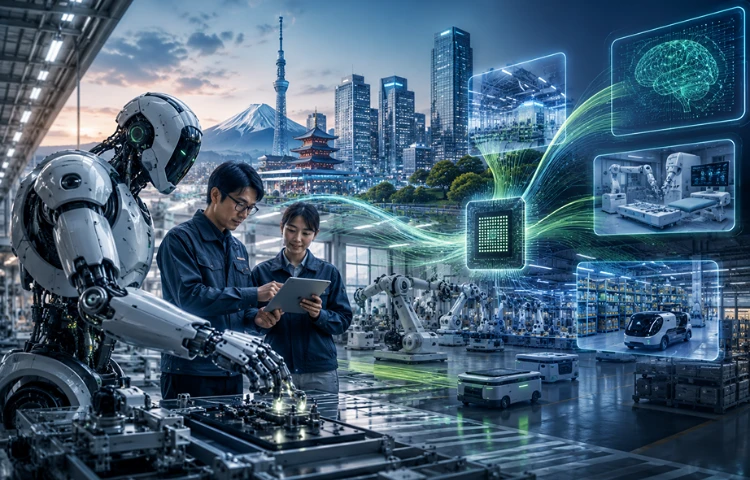
The global artificial intelligence race is moving beyond chatbots, digital assistants and software automation. Its next major destination is the physical world—and Japan wants to be one of the countries leading the charge.
Nvidia announced that it was working with major Japanese technology and robotics companies to advance the development of artificial intelligence-powered machines. The initiative brings Nvidia together with Fujitsu and leading industrial robotics manufacturers Fanuc, Yaskawa Electric and Kawasaki Heavy Industries.
The collaboration matters because it combines two highly complementary capabilities: Nvidia’s AI computing and software platforms with Japan’s decades of expertise in precision engineering, industrial automation and robotics.
According to [Reuters] Nvidia CEO Jensen Huang said AI would make robots smarter, more adaptable and more accessible. That vision represents a significant shift from traditional robots that repeatedly perform one programmed task toward machines that can perceive their surroundings, reason about changing conditions and adjust their behavior in real time.
The initiative is centered on the development of physical AI—artificial intelligence that can interact with and act within the real world.
Fujitsu is exploring the creation of a collaborative control platform that would integrate Nvidia’s physical AI technologies with robotic systems produced by Fanuc, Yaskawa Electric and Kawasaki Heavy Industries. The goal is to connect digital intelligence with physical machinery across industries such as manufacturing, healthcare, logistics, agriculture, mobility and infrastructure.
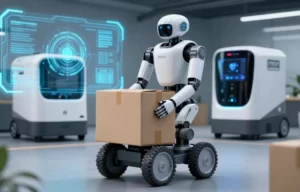
Unlike conventional industrial robots, which normally follow carefully programmed instructions within controlled environments, physical AI systems are designed to understand more complex situations. They may use cameras, sensors, language models, simulation engines and real-time reasoning to decide what action to take.
For example, a traditional factory robot may be programmed to pick up the same component from the same location thousands of times. A physical AI robot could potentially recognize components placed in different positions, adapt its grip, identify defects and respond safely when a human enters its workspace.
The [AP] notes that the participating companies see possible applications in factories, hospitals and homes. The first phase of the collaboration is expected to begin during 2026, although the companies have not announced a firm timetable for widespread commercial deployment or confirmed plans for a separate joint venture.
Nvidia is no longer simply a supplier of graphics processing units. The company has assembled a broad robotics ecosystem covering AI training, synthetic-data generation, simulation, computer vision and deployment on physical machines.
The Japanese partners are expected to work with several parts of Nvidia’s technology stack:
Cosmos is a family of world foundation models designed to help AI systems understand physical environments. World models can learn patterns involving movement, objects, cause and effect, and spatial relationships.
Nvidia also introduced Cosmos 3 Edge, a four-billion-parameter model designed to run on edge computing platforms. Running AI at the edge allows robots to process information close to where it is generated rather than constantly sending data to a distant cloud server.
This is important for applications where latency, connectivity and privacy matter. A robot working beside a factory employee cannot always afford to wait for a remote data center before responding to an unexpected movement.
Nvidia Isaac provides software, models and development tools for building intelligent robots. Developers can use it to train robotic systems, test perception models and create workflows that connect AI decision-making with physical actions.
Omniverse enables companies to create digital twins—virtual representations of factories, warehouses, machines or other physical environments. Developers can use these simulated environments to train and test robots before placing them near expensive machinery or human workers.
Simulation can reduce development costs while allowing teams to test unusual, hazardous or rare scenarios. A robot can make millions of virtual mistakes without damaging real equipment.
Jetson systems provide AI computing power directly inside robots, autonomous machines and smart devices. This on-device processing helps robots analyze sensor data and make decisions in real time.
In its [official announcement about Japan’s physical AI ecosystem] Nvidia said participating companies intend to use technologies including Cosmos, Isaac, Metropolis and Jetson. It also said a wider group of Japanese businesses plans to join the Nvidia Cosmos Coalition and contribute to the development of open physical AI models.
Japan has been a robotics powerhouse for decades. Fanuc and Yaskawa Electric are among the most established manufacturers of industrial robots and automation systems, while Kawasaki Heavy Industries applies robotics across manufacturing, healthcare, transportation, aerospace and other sectors.
These companies understand how to build machines that operate with high precision and reliability. Nvidia contributes the computing architecture and AI development platforms needed to make those machines more flexible and intelligent.
This creates a potentially powerful combination:
Japan supplies robotics and manufacturing expertise. Nvidia supplies accelerated computing, AI models and simulation software.
Japan also has strong economic and social incentives to accelerate automation. Its aging population and labor shortages are creating staffing pressures in manufacturing, healthcare, elder care, agriculture, retail and logistics.
Physical AI could help organizations support workers rather than simply replace them. Robots might handle repetitive lifting, transport medical supplies, inspect dangerous industrial areas or assist caregivers with physically demanding tasks. Human employees could then focus on judgment, communication and work requiring empathy or creativity.
Kawasaki Heavy Industries is already taking steps in this direction. In its [announcement establishing a Physical AI Center in Silicon Valley] the company said its initial focus would include healthcare and elder care. Kawasaki emphasized that its objective was not to replace people, but to build systems that safely support human judgment and action.
The partnership could change how industrial robots are designed, programmed and deployed.
Many factory robots currently require specialist engineers to program individual movements. Reconfiguring a production line can therefore take significant time and technical expertise.
Physical AI could make robot programming more intuitive. In the future, an employee might demonstrate a task, describe it using natural language or provide a small set of examples. The robot could use those instructions to generate an initial action plan, practice the task in simulation and refine its behavior before operating on the factory floor.
That does not mean factories will immediately be filled with completely autonomous humanoid robots. Near-term progress is more likely to involve practical improvements to existing industrial machines, including:
These incremental improvements could deliver considerable value. Even a modest reduction in production downtime, programming effort or defective output can produce meaningful savings at industrial scale.
Advanced robotics requires more than intelligent machines. Companies also need large-scale computing infrastructure to train models, process industrial data and run realistic simulations.
In a development announced alongside the robotics partnership, government-backed Japanese company Noetra said it planned to purchase 27,500 of Nvidia’s next-generation Rubin chips for physical AI development. Reuters reported that construction of the related infrastructure was expected to begin in April 2027, with operations scheduled to start in June 2028.
This investment suggests Japan is not treating physical AI as a collection of isolated robotics experiments. It is building a broader ecosystem involving computing capacity, industrial data, AI models, robotics hardware and domestic technology companies.
Such infrastructure could allow Japanese businesses to train systems using locally generated manufacturing, mobility and healthcare data. It may also help them retain greater control over sensitive industrial information.
The partnership presents major opportunities, but it also raises strategic questions.
An [analysis from Japan’s Institute of Geoeconomics] argues that physical AI foundation models may occupy one of the most valuable positions in the robotics value chain. If Japanese manufacturers rely heavily on external AI platforms, they could become excellent hardware suppliers while much of the software, data and platform value accumulates elsewhere.
Japanese robotics firms will therefore need to determine how much of their software architecture, operational data and intellectual property should remain under their control.
The ideal partnership would allow Japanese companies to benefit from Nvidia’s ecosystem while continuing to develop proprietary expertise. Industrial data generated by factories, hospitals and transportation systems may become one of the most important competitive resources in physical AI.
Other challenges include cybersecurity, interoperability, power consumption and vendor concentration. Businesses adopting AI robotics should avoid becoming dependent on a single model, chip architecture or software platform without a clear continuity strategy.
Errors made by a text-based AI system may produce inaccurate information. Errors made by a physical AI system can damage equipment or injure people.
Safety must therefore be treated as a fundamental design requirement rather than a final compliance exercise.
Organizations developing or deploying AI-powered robots will need rigorous processes for:
Physical AI also introduces privacy concerns. Robots used in hospitals, stores, offices and homes may collect detailed visual and behavioral data. Companies must establish clear rules covering what data is gathered, how long it is retained, where it is processed and who can access it.
The strongest physical AI systems will not merely be capable. They will be predictable, auditable and worthy of trust.
For manufacturers, logistics providers and healthcare organizations, the announcement is a signal to begin preparing for a new generation of automation.
Businesses do not need to purchase humanoid robots tomorrow. However, they should start identifying tasks where physical AI could deliver measurable value.
Good early candidates include repetitive work, hazardous inspections, quality assurance, material movement and operations affected by chronic labor shortages. Organizations can then create limited pilot programs, measure performance and expand only after establishing reliable safety and financial results.
Technology leaders should also review whether their existing data is suitable for physical AI. Robotics systems may require video, sensor readings, machine logs, maintenance records and detailed representations of operating environments. Poorly organized data can become a significant barrier to adoption.
Workforce planning is equally important. Employees will need training to supervise, maintain and collaborate with intelligent machines. Companies that communicate openly about how robotics will affect roles are more likely to gain employee trust and discover useful applications from the people who understand daily operations best.
Japan’s growing investment in physical AI signals a major shift in how artificial intelligence will shape the real world. By combining advanced computing, robotics expertise, and industrial experience, this collaboration could accelerate the development of machines that are safer, smarter, and more adaptable.
The biggest opportunities may appear in manufacturing, healthcare, logistics, and other sectors facing labor shortages or demanding working conditions. However, the long-term success of AI-powered robotics will depend on more than technical performance. Businesses and policymakers must also address safety, data privacy, cybersecurity, workforce training, and accountability.
Physical AI is not simply about building robots that can do more. It is about designing systems that can work responsibly alongside people. As Japan strengthens its position in intelligent robotics, the country could help define how AI moves from software into factories, hospitals, and everyday life.
The next era of AI will not just answer questions. It will see, move, learn, and act—and the decisions made today will determine whether that future is both innovative and trustworthy.






WEBINAR