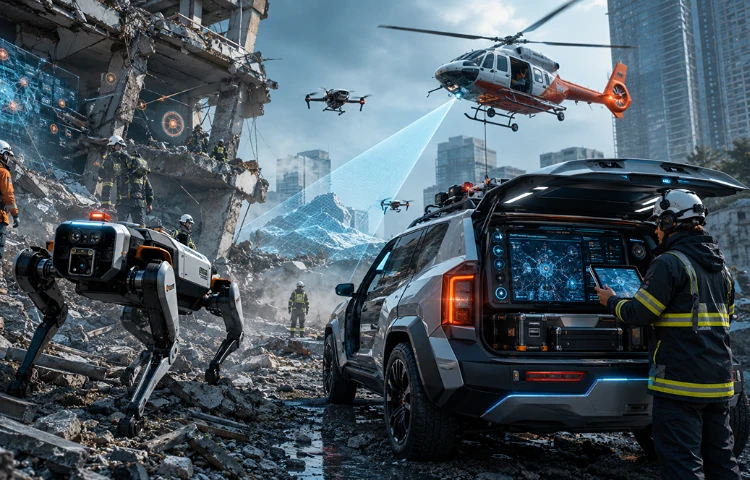
Robot dogs stepping over rubble. Electric vehicles packed with cameras and computing power. Rescue helicopters supported by intelligent navigation systems. It sounds like the opening scene of a science-fiction blockbuster, but these technologies are rapidly becoming part of a serious global conversation about artificial intelligence.
“Robot Dogs, Teslas, and Rescue Helicopters” captures the strange yet revealing mix of machines displayed and discussed at the United Nations’ AI for Good Global Summit. As described in [WIRED] the summit combined live coding, ambitious promises, autonomous machines, policy discussions, and enough futuristic hardware to make an ordinary technology conference look rather sleepy.
Behind the spectacle, however, was a much more important question: Can governments, businesses, humanitarian organizations, and communities agree on what “AI for good” actually means before the technology races too far ahead?
Robot Dogs Are Becoming Serious Rescue Tools
Robot dogs may attract attention because of their uncanny movements, but their four-legged design serves a practical purpose. Wheels work well on smooth surfaces. Disaster zones are rarely smooth.
Collapsed buildings, loose rubble, staircases, flooded streets, narrow passages, and unstable ground can stop conventional vehicles. A quadruped robot can step over obstacles, adjust its balance, crouch beneath damaged structures, and enter places that may be too dangerous for a human rescuer.
An AI-powered robot dog developed by engineering students at Texas A&M, detailed by [RoboHub] was designed to navigate chaotic environments while using artificial intelligence to interpret what it encounters. Rather than merely following a fixed remote-control command, a more advanced rescue robot can use cameras, LiDAR, thermal sensors, mapping tools, and machine-learning models to recognize objects, remember locations, and help identify potential hazards or survivors.
This does not mean robot dogs are about to replace firefighters, paramedics, or search-and-rescue specialists. Their greatest value is as an extension of the human team.
A robot can enter a structurally unstable building first, transmit live video, measure environmental conditions, create a three-dimensional map, and mark possible survivor locations. Human responders can then make better decisions without being exposed unnecessarily to fire, toxic materials, falling debris, or secondary structural collapse.
The winning model is not robot versus rescuer. It is robot plus rescuer.
What Do Teslas Have to Do With AI for Good?
Seeing a Tesla Cybertruck at an AI summit may feel slightly less humanitarian than watching a rescue robot crawl through simulated wreckage. However, its presence reflects a much broader shift: artificial intelligence is moving out of computer screens and into physical machines.
Modern vehicles increasingly function as computers on wheels. They combine cameras, sensors, mapping information, connectivity, software updates, driver-assistance systems, and enormous amounts of real-world data. Whether the vehicle is made by Tesla or another manufacturer, the underlying trend is the same. Transportation is becoming more software-defined and increasingly dependent on AI-assisted perception and decision-making.
In an emergency, intelligent electric vehicles could potentially support responders by transporting supplies, providing mobile electrical power, collecting environmental data, or maintaining communication links. Fleets could also be coordinated using AI systems that analyze road closures, weather conditions, hospital capacity, traffic congestion, and the location of emergency personnel.
However, a flashy vehicle at a technology summit should not automatically be treated as proof of humanitarian impact. A product becomes socially valuable only when it solves a clearly defined problem, works reliably under difficult conditions, and remains accessible to the people who need it.
That distinction matters. “AI for good” should be measured through outcomes—not horsepower, product launches, stage demonstrations, or the number of cameras attached to a machine.
Rescue Helicopters Are Becoming Intelligent Data Platforms
Rescue aviation is another area where AI could deliver meaningful benefits. Helicopter crews routinely operate in poor visibility, severe weather, mountainous terrain, wildfires, floods, and other conditions where a small error can have devastating consequences.
AI-assisted systems can help analyze terrain, combine thermal and visual imagery, detect unusual patterns, identify potential landing zones, and prioritize search areas. Unmanned aircraft can also scout dangerous locations before a crewed helicopter enters the area.
NASA has explored autonomous systems that use AI-enabled cameras to identify survivors, aircraft debris, and flight equipment while creating maps for rescue and recovery teams. Its autonomous system research shows how unmanned aerial systems can provide live information while reducing the need to place rescue personnel in hazardous environments.
The most effective emergency operation may therefore involve several connected machines working together. A drone could survey a wide area from above. A robot dog could inspect a damaged structure. An intelligent ground vehicle could transport equipment. A helicopter crew could then act on a clearer and more complete picture of the emergency.
This coordinated approach is far more valuable than treating every robot, vehicle, or aircraft as an isolated gadget.
The Real Challenge Is Coordination, Not Hardware
The technology is impressive. The difficult part is making it dependable in the real world.
Disaster areas may have damaged cellular networks, limited electricity, smoke-filled skies, blocked roads, inaccurate maps, and extreme weather. Rescue teams from different agencies may use incompatible communication systems. An AI tool that performs perfectly during a controlled demonstration may struggle when its sensors are covered in dust, its connection disappears, or the environment looks different from its training data.
For this reason, emergency AI systems need rigorous testing, common technical standards, secure communications, backup operating modes, and clear chains of human authority.
Responders must also understand what a system can and cannot do. A confidence score generated by a computer should never be mistaken for certainty. If a rescue robot fails to identify a survivor, or an aerial system incorrectly classifies an object, the consequences could be life-changing.
Human oversight is therefore not a decorative ethical slogan. It is an operational necessity.
Conclusion: The Future Depends on Responsible Deployment
Robot dogs, intelligent vehicles, and AI-assisted rescue helicopters show how quickly artificial intelligence is moving beyond software and into the physical world. These technologies have the potential to improve emergency response, reduce risks for frontline workers, and help teams reach people in dangerous or inaccessible locations. Their real value, however, will not be determined by how futuristic they look, but by how safely, fairly, and reliably they perform under real-world pressure.
For AI-powered machines to deliver meaningful public benefit, innovation must be supported by strong governance, human oversight, data protection, reliable infrastructure, and clear accountability. Governments, technology companies, emergency services, and local communities must work together to ensure these systems remain practical, accessible, and focused on genuine human needs.
The future of rescue technology will not be defined by machines replacing people. It will be defined by machines helping trained professionals make faster, safer, and better-informed decisions. When innovation is guided by responsibility, robot dogs, smart vehicles, and autonomous aircraft can become more than impressive demonstrations—they can become trusted tools that help save lives.