Artificial intelligence has officially outgrown the lab. What was once a race to build smarter models is now a race to build the infrastructure powerful enough to run them. That is why the Google–Blackstone AI cloud venture is such a major development for the technology industry. As businesses rapidly adopt generative AI, automation, advanced analytics, and machine learning systems, the demand for high-performance cloud computing and data center capacity is rising at an unprecedented pace.
Google and Blackstone’s planned AI cloud venture is designed to address this growing pressure by combining Google’s cloud and AI hardware expertise with Blackstone’s massive infrastructure investment capabilities. At the center of the partnership is a bigger goal: expanding access to the computing power enterprises need to train, deploy, and scale AI applications efficiently.
For business leaders, developers, investors, and technology teams, this deal is more than another headline. It highlights a critical shift in the AI market: the future of artificial intelligence will depend not only on better algorithms, but also on stronger data centers, specialized chips, reliable energy, and scalable cloud platforms. In this blog, we explore what the Google–Blackstone AI cloud venture means, why data center demand is accelerating, and how this partnership could shape the next phase of enterprise AI.
The AI boom has a new bottleneck: infrastructure
The Google Blackstone AI cloud venture is not just another Big Tech partnership. It is a loud, flashing signal that the AI race has moved beyond model demos and chatbot launches into something more physical: power, chips, cooling, networking, and data center capacity. According to Reuters, Alphabet’s Google and Blackstone announced a U.S.-based artificial intelligence cloud business designed to meet surging demand for AI computing services, with Blackstone making an initial $5 billion equity commitment to bring 500 megawatts of data center capacity online in 2027. [Reuters]
What Google and Blackstone are building
Blackstone’s official announcement describes the new venture as a company that will offer data center capacity, operations, networking, and Google Cloud Tensor Processing Units as a compute-as-a-service offering. The company is intended to give customers another way to access Google’s Cloud TPUs in addition to using them directly through Google Cloud. [Blackstone]
In plain English: Google brings the AI chips, software, and infrastructure know-how; Blackstone brings the capital, real estate, energy, and data center investment muscle. It is a classic “brains plus buildout” model. Google’s TPUs are custom AI accelerators designed for machine learning workloads, and Google Cloud’s documentation explains that Cloud TPUs are application-specific integrated circuits used to accelerate machine learning and can be accessed through services such as Compute Engine, Google Kubernetes Engine, and Vertex AI.
This structure is important because AI infrastructure is becoming too capital-intensive for ordinary cloud expansion playbooks. Blackstone says the venture will initially bring 500 MW online in 2027, with plans to scale significantly over time, while Reuters reported that the total investment value could reach $25 billion including leverage.
Why this deal matters for enterprises
For business leaders, the most important takeaway is not “Google and Blackstone are spending a lot of money.” The real takeaway is that AI capacity is becoming a strategic resource.
Companies that want to deploy AI at scale increasingly need predictable access to compute. A proof-of-concept chatbot can run on modest infrastructure. But enterprise-grade AI workflows—customer support automation, internal knowledge systems, advanced analytics, model fine-tuning, multimodal search, AI coding assistants, and agentic workflows—can require large amounts of low-latency, high-performance infrastructure. CIO Dive framed the new venture as a compute-as-a-service play designed to increase flexibility for enterprises running AI workloads as cloud infrastructure spending rises. [ciodive]
TPUs vs. GPUs: why Google is pushing its own AI hardware
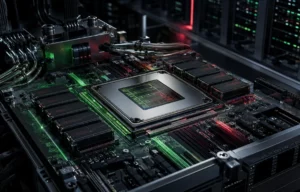
Much of today’s AI infrastructure conversation revolves around Nvidia GPUs, and for good reason: GPUs have powered much of the generative AI boom. But Google’s TPU strategy offers a different path. TPUs are purpose-built for machine learning, especially large matrix operations common in training and inference. Google Cloud’s TPU introduction explains that TPUs include high-bandwidth memory, can be connected in scalable groups called slices, and are compiled through XLA to run machine learning workloads efficiently.
That makes the Google Blackstone AI cloud venture a potential challenge to the GPU-heavy “neocloud” model. The Financial Times reported that the venture is one of Google’s boldest efforts to expand access to its custom AI chips and compete more directly in the AI infrastructure market. [Financial Times]
The short version for enterprise buyers: more chip options could mean more flexibility, better workload matching, and potentially better economics. Not every AI workload needs the exact same hardware. Some teams may prefer Nvidia-based environments because of ecosystem maturity. Others may choose TPUs for Google-native AI workflows, large-scale model training, inference efficiency, or deeper integration with Google Cloud services.
The bigger trend: AI infrastructure is becoming an asset class
This deal also shows how deeply AI is reshaping investment strategy. Blackstone is not treating AI as a software trend; it is treating AI infrastructure as a generational capital deployment opportunity. Its announcement notes that Blackstone has more than $1.3 trillion in assets under management and calls the joint venture a way to meet unprecedented demand for compute.
That is a huge clue about where the market is heading. AI infrastructure is becoming a financial asset class, much like logistics warehouses, fiber networks, renewable energy, and cloud real estate. The companies that control compute capacity may influence how quickly enterprises can deploy AI, how much it costs, and which platforms become default choices.
The sustainability and governance questions
Here is where the story gets more serious. A 500 MW data center buildout is not just a technology milestone; it is an energy, sustainability, and regulatory issue. AI data centers require enormous power and water resources, depending on location, cooling design, and energy mix. As AI infrastructure expands, enterprises and policymakers will need clearer standards around carbon impact, renewable energy sourcing, grid resilience, community impact, data security, and responsible AI deployment.
The Google–Blackstone venture could help meet the world’s growing appetite for AI compute, but it also raises big questions: Who gets access to scarce compute? How transparent will pricing be? How will companies measure the environmental footprint of their AI workloads? And how will organizations ensure that faster AI deployment does not outpace governance?
For enterprise leaders, the answer is not to avoid AI infrastructure decisions. It is to make them intentionally. Vendor selection should include performance, cost, security, compliance, sustainability, and long-term portability. AI strategy is becoming infrastructure strategy. Fun times for CIOs; slightly less fun for anyone hoping “just buy a chatbot” was the whole plan.
Conclusion
The Google–Blackstone AI cloud venture marks a defining moment in the evolution of artificial intelligence. As AI adoption accelerates across industries, the demand for powerful, reliable, and scalable data center infrastructure is becoming just as important as the models themselves. This partnership shows that the next phase of AI growth will be built on advanced cloud platforms, specialized chips, massive compute capacity, and long-term infrastructure investment.
For businesses, the message is clear: AI strategy can no longer be separated from infrastructure strategy. Companies that want to deploy AI at scale must think carefully about cloud capacity, performance, cost, governance, sustainability, and security. The organizations that prepare now will be better positioned to turn AI from an experimental tool into a real driver of productivity, innovation, and competitive advantage.
Ultimately, the Google–Blackstone partnership is more than a response to rising data center demand. It is a sign of where the AI economy is heading. The winners of the next decade will not only be those who build the smartest AI systems, but those who have the infrastructure, partnerships, and responsible deployment strategies to make those systems work at scale.