Artificial intelligence has taught robots how to see, recognize, reason and increasingly plan. But there is still one surprisingly human capability that machines struggle to reproduce: knowing what something feels like.
That gap may be closing.
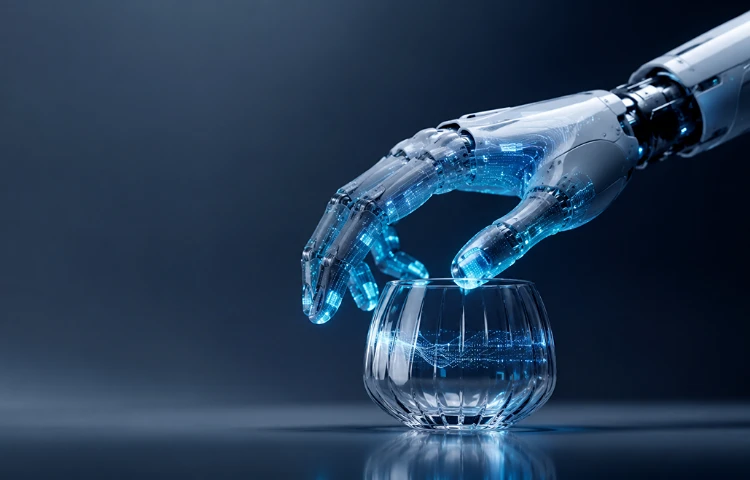
Touch-sensitive electronic skin, or e-skin, is emerging as one of the most promising technologies in robotics. Flexible sensor systems can give machines the ability to detect pressure, contact, force, slipping and—in increasingly sophisticated designs—multiple types of physical stimuli across large areas of a robot’s body.
That matters because vision alone cannot tell a robot everything it needs to know.
Imagine a robotic hand picking up a strawberry. A camera can identify the fruit and estimate its location. But once the fingers make contact, the robot needs to determine whether the strawberry is secure, whether it is starting to slip, and whether additional grip force will turn lunch into jam.
This is where tactile intelligence enters the picture.
Touchlab CEO Zaki Hussein recently described the commercialization challenge succinctly in a [TechRadar discussion of touch-sensitive e-skin for robotics] “Groundbreaking technology often enters the market at a premium before scaling.” Touchlab’s goal is to make tactile sensing sufficiently practical and affordable that it eventually becomes a standard component of commercial robots rather than an exotic research feature.
That transition could become an important chapter in the rise of physical AI.
What Is Touch-Sensitive E-Skin?
Electronic skin is a broad category of thin, flexible or stretchable sensor technology designed to reproduce some of the sensory capabilities associated with biological skin.
Rather than installing a handful of rigid force sensors into a robotic gripper, engineers can potentially cover fingers, palms, arms or even much of a robot’s body with distributed sensing surfaces.
Touchlab takes another approach. Its technology uses quantum tunneling-based sensing to measure forces through an extremely thin material. According to the company in its TechRadar interview, the technology can support very rapid responses while measuring characteristics such as pressure, force and direction.
The bigger idea is simple: rather than merely telling a robot that contact happened, advanced e-skin can provide richer information about how that contact is changing.
For robots working around unpredictable objects and people, that difference is enormous.
E-Skin Could Make Robotic Hands Dramatically More Useful
Dexterity is becoming one of the biggest competitive frontiers in humanoid and general-purpose robotics.
Walking looks impressive in a product demonstration. Manipulating unpredictable everyday objects reliably is often much harder.
Plastic bags deform. Fruit bruises. Fabric folds. Tools can rotate inside a hand. Bottles become slippery. Electrical components can be damaged by excess pressure.
A sophisticated tactile system could help a robot recognize these changes as they happen.
Research is already demonstrating the value of combining tactile sensing with more capable hands. A 2025 Nature Communications paper, [Soft robotic hand with tactile palm-finger coordination] describes a robotic hand integrating high-density tactile sensing in the palm with soft fingers and coordinated manipulation strategies.
That is important because useful robotic manipulation will likely require more than increasingly sophisticated AI models. It requires a complete feedback loop:
Perceive → decide → act → feel → adjust.
The “feel” stage has historically been much weaker than the others.
E-skin could change that.
Edge Computing Could Give Robots Faster Physical Reflexes
Tactile sensing also creates an interesting computing challenge.
A robot covered in thousands of sensing points could potentially generate an enormous amount of information. Sending every tiny change to a centralized computer—or worse, across a network to a cloud service—could introduce unnecessary bandwidth requirements and latency.
A more practical approach is to process some tactile information at the edge, close to where it is generated.
Touchlab describes a shared-autonomy architecture in which low-level tactile reflexes, such as preventing an object from slipping, can be handled locally while a human operator or higher-level AI concentrates on broader decisions.
That resembles the division of labor in biological systems. You do not consciously calculate every tiny pressure adjustment required to keep a coffee mug from sliding through your fingers. Many responses occur automatically.
Giving robots a comparable low-level feedback layer could reduce both computational overhead and reaction time.
Manufacturing E-Skin at Scale Is the Real Test
Producing an impressive sensor in a laboratory is one thing.
Producing thousands or millions of reliable, affordable sensors that survive industrial use is something else entirely.
E-skin must potentially withstand bending, impact, repeated contact, abrasion, temperature changes and thousands—or millions—of manipulation cycles.
It also has to conform to irregular robotic surfaces while maintaining consistent measurements.
Manufacturing complexity is therefore one of the biggest barriers between advanced tactile sensing and widespread deployment.
A 2026 study in npj Flexible Electronics, [Scalable in-situ fabrication of multimodal electronic skin for intelligent interactive systems] specifically highlights scalability and customization as persistent limitations for many multimodal e-skin platforms because existing approaches can depend on complicated fabrication and assembly processes.
That helps explain why the “premium before scaling” argument matters.
Early commercial deployments do not necessarily need maximum possible sensor density across every square centimeter of a robot.
A manufacturer might instead place high-performance tactile sensing where it creates the greatest operational value: fingertips, palms, grippers or surfaces likely to encounter humans.
As production improves and costs fall, coverage can expand.
This is a familiar technology curve. What begins as specialized hardware can eventually become a commodity component once manufacturing processes, supply chains and standards mature.
The Business Case Goes Beyond Humanoid Robots
Humanoid robots may generate the headlines, but e-skin’s commercial potential is considerably broader.
Manufacturing
Industrial robots equipped with distributed tactile sensing could become better at handling irregular, fragile or variable components instead of relying exclusively on perfectly controlled production environments.
Healthcare and Assisted Living
Robots working near patients need exceptionally careful force control.
A machine helping someone reposition an arm, handing over an object or supporting mobility cannot behave like an industrial machine behind a safety cage.
Robotic skin could provide another layer of awareness when physical contact occurs.
Warehousing and Logistics
Tactile sensing could help robots grip oddly shaped packaging, identify unstable loads and handle objects whose physical properties vary even when their visual appearance is similar.
Home Robotics
Homes may ultimately be one of the strongest arguments for tactile robotics.
Unlike factories, homes are almost completely uncontrolled environments. Objects move constantly. Surfaces vary. Children, adults and pets may occupy the same space.
A robot expected to fold laundry, clear a table or assist an older adult needs more than object recognition. It needs continuously adaptive physical behavior.
Safety, Privacy and Standards Cannot Be an Afterthought
As physical AI becomes more capable, governance becomes more important.
A robot making decisions in software can generate an incorrect output. A robot making decisions in the physical world can move machinery, touch a patient, carry equipment or interact directly with a person.
Tactile sensing may improve safety by helping machines detect unexpected contact and regulate force, but organizations still need clear rules for testing, accountability, data governance and system failure.
Touchlab has also emphasized that tactile data can exist alongside video, audio, LiDAR and other sensor streams. Although tactile readings themselves may not identify a person, combining multiple streams can create broader privacy and security concerns.
Businesses deploying intelligent robotics should therefore treat security and governance as system-level requirements rather than individual sensor problems.
Standards will matter too. Comparable metrics for tactile sensitivity, spatial resolution, response time, durability and force detection could make it easier for robotics manufacturers to evaluate competing technologies.
Standardization is often less exciting than a humanoid demonstration—but it is frequently what transforms an emerging technology into infrastructure.
From Premium Technology to Standard Robotic Equipment
The most important question may therefore not be whether electronic skin works.
There is already significant research showing that flexible tactile sensing can provide remarkable sensitivity and enable increasingly sophisticated robotic interactions. A 2025 review of e-skin technologies describes the field as a convergence of advanced materials, sensors, AI and edge computing with major potential in robotics and human-machine interaction.
The question is whether the technology can become sufficiently durable, standardized, manufacturable and inexpensive to appear routinely in commercial machines.
That is why Hussein’s premium-to-scale observation is so relevant.
The first generation of advanced e-skin robots may be expensive. They may appear primarily in high-value environments where better manipulation or safer human interaction justifies the cost.
But commercialization rarely ends where it starts.
Production volumes increase. Manufacturing improves. Electronics become cheaper. Software becomes reusable. Standards emerge. Suppliers compete.
Eventually, something that once looked experimental can become simply another component on the bill of materials.
The Next Era of Physical AI May Be About Feeling
AI’s transition from digital assistants to machines operating in the physical world fundamentally changes what intelligence requires.
A chatbot needs to understand words.
A robot needs to understand consequences in three-dimensional space.
Vision tells it what an object looks like. AI reasoning tells it what the object may be and what should happen next. Motors let it act.
Touch tells it what is happening right now.
That final feedback loop could be one of the technologies that makes the difference between robots that perform carefully staged demonstrations and robots capable of working reliably beside people.
Touch-sensitive e-skin will not become commonplace simply because researchers can make impressive sensors. It will happen when robotics companies can deliver the right amount of tactile intelligence at the right price, package it into durable hardware, process its data efficiently and demonstrate that it improves real-world performance.
If that happens, electronic skin could follow the trajectory of cameras, accelerometers and other technologies that began as premium capabilities before becoming ordinary components.
And when that transition arrives, the smartest robots may no longer be defined only by what they can see or think.
They may be defined by what they can feel.
Conclusion
Touch-sensitive e-skin could be a major step forward for robotics because it gives machines something they have largely been missing: the ability to feel and respond to physical contact.
With e-skin, robots could handle fragile objects more carefully, work more safely around people, react faster when something slips, and perform more complex tasks in factories, hospitals, warehouses, and homes.
The technology is still relatively expensive and difficult to manufacture at scale, but that is common with new innovations. As production improves, costs may fall and e-skin could become a standard feature in future robots.
The bigger takeaway is simple: robots are becoming more useful because they are learning to combine sight, intelligence, movement, and touch. If tactile sensing continues to improve, the next generation of robots may not just see and understand the world around them—they may be able to feel it too.