Humanoid robots just crossed another line that would have sounded like science fiction only a few years ago.
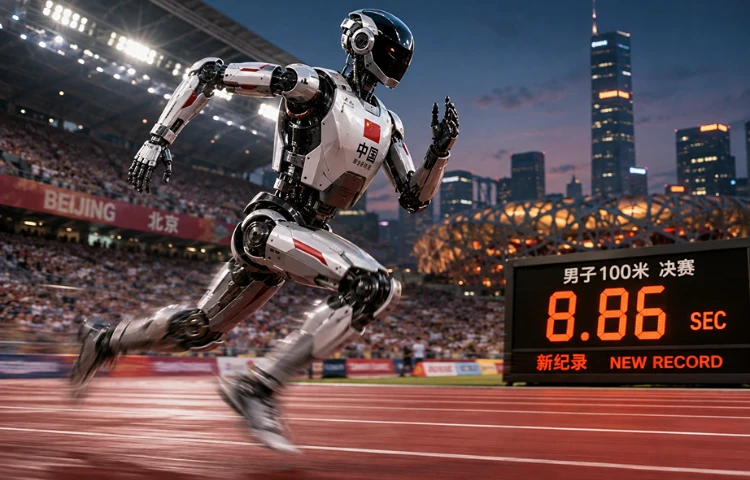
China’s Tiangong Ultra humanoid robot completed 100 metres in just 8.86 seconds during a semifinal at the 2026 World Humanoid Robot Games in Beijing, dramatically lowering the 9.39-second time it recorded earlier in the competition. Reuters reported that the result came in the large-size robot division on August 25 and put Tiangong more than seven-tenths of a second inside the famous 9.58-second human benchmark set by Usain Bolt in 2009. [Reuters]
That headline is spectacular. The technology behind it is arguably even more interesting.
Tiangong’s run is not simply a story about creating a machine that moves quickly. It demonstrates how rapidly physical AI, motion-control algorithms, actuators, autonomous navigation, mechanical engineering and real-time sensor processing are converging.
And those technologies could ultimately matter far more in factories, warehouses and infrastructure projects than they do on a running track.
From 21.50 Seconds to 8.86: A Remarkable One-Year Improvement
The scale of Tiangong’s improvement deserves some perspective.
At the inaugural World Humanoid Robot Games in 2025, Tiangong Ultra won the 100 metres in 21.50 seconds. One year later, its reported semifinal time is 8.86 seconds.
That means the robot has shaved 12.64 seconds—nearly 59%—off its 100-metre time in roughly a year.
At 8.86 seconds, its average speed across 100 metres works out to roughly 40.6 kilometres per hour, or about 25.3 mph.
That is quite a jump for a machine that needs to continuously balance a tall, articulated body while transferring force through two legs.
There is an important distinction, however: Tiangong has not replaced Usain Bolt as the World Athletics record holder. It has run the same distance in a lower recorded time, but robots and human athletes compete under entirely different categories, engineering constraints and rule systems.
So, no, Bolt does not need to return his medals to a robot.
But as a robotics benchmark, the result is extraordinary.
What Changed Inside Tiangong Ultra?
The biggest question is how a humanoid robot could improve so dramatically in such a short period.
According to technical details provided by the Beijing Humanoid Robot Innovation Center, Tiangong Ultra received upgrades to both its hardware and software. The robot reportedly uses improved joints, a lighter structure and a more streamlined physical design, while its control and navigation algorithms have also been optimized for high-speed running. The Center also described a move from simple track-line following toward map-based positioning, allowing the robot to navigate at speed without depending exclusively on painted lane markings. [Global Times]
That combination matters.
Running is an unforgiving robotics problem. Every stride involves balancing the robot on effectively one leg for part of the gait cycle while constantly adjusting joint torque, foot placement, body angle and momentum.
The robot needs to process sensor data, predict its next movement and correct small errors before they become large ones.
At sprinting speeds, it has very little time to think about it.
This is exactly why the broader development of physical AI is becoming such an important area of technology. Unlike a chatbot, which operates almost entirely in the digital world, physical AI must turn decisions into actions while dealing with gravity, friction, unpredictable environments and hardware limitations.
The World Humanoid Robot Games Are Becoming a Serious Technology Testbed
The setting is also important.
The second World Humanoid Robot Games, held at Beijing’s National Speed Skating Oval from August 22–26, have expanded dramatically.
According to official Beijing government information, the 2026 competition includes 2,056 robots from 666 teams, participating in 51 events and 1,301 competition sessions. The program includes 30 competitive events and 21 scenario-based challenges.
Those challenges go well beyond sprinting.
Robots are being tested in football, martial arts, dancesport and athletics, but also in environments intended to resemble factories, hotels, logistics facilities and other workplaces.
That shift is crucial.
Robot racing is entertaining. A robot that can reliably manipulate unfamiliar objects, identify equipment, navigate a changing building and recover from mistakes could create real economic value.
Being Faster Than Bolt Is Impressive. Plugging in a Cable May Be More Important.
There is a delightful irony in the current generation of humanoid robots.
Some can apparently sprint 100 metres faster than any human in recorded history.
Then they can struggle with a cable.
Reuters highlighted precisely this contrast in its broader reporting from the Games, noting that scenario-based competitions are testing robots on tasks such as connecting cables, charging electric vehicles, handling restaurant work and performing industrial operations. More than 40% of the relevant tests reportedly require full autonomy. [Reuters]
That is a useful reminder of how robotics progress should be measured.
A humanoid robot that runs extremely quickly demonstrates advanced locomotion, balance and mechanical performance. But a commercially useful robot also needs perception, dexterity, adaptability, reliability and safe decision-making.
The difference is similar to the difference between passing one difficult exam and being good at an entire profession.
Running is one skill.
Working in a messy human environment is thousands of skills stitched together.
Why Humanoid Form Factors Matter
Why build robots with two legs at all?
After all, wheels are generally simpler, more stable and more energy efficient.
The answer is largely that our world was built for humans.
Factories have stairs. Offices have doors. Warehouses have shelves at human heights. Homes contain handles, switches, tools, furniture and appliances designed around human bodies.
A capable humanoid robot could potentially operate within existing infrastructure without businesses rebuilding every workplace around a specialized machine.
That explains why so much investment is flowing into humanoid robotics.
The long-term objective is not necessarily to build machines that look impressive while sprinting around stadiums. It is to develop machines that can walk into environments designed for people and perform useful work there.
Speed Is Only Half the Story—Stopping Matters Too
There is also an amusing but important caveat hiding behind some of these spectacular sprint times.
Fast humanoid robots do not always stop particularly elegantly.
Coverage of the earlier 9.39-second performance showed robots relying on padded areas after races, highlighting the challenge of rapidly dissipating momentum while maintaining balance.
That matters because the ability to accelerate is only one component of useful mobility.
Real-world robots must also decelerate, change direction, avoid people, respond to unexpected obstacles and recover safely when something goes wrong.
In a warehouse, hospital or crowded workplace, smashing a speed record before smashing into the nearest wall would be a fairly serious design flaw.
The next major robotics milestone therefore may not be another tenth of a second removed from a sprint time. It may be achieving similar speed while demonstrating much more sophisticated control before, during and after the run.
What Tiangong’s Sprint Could Mean for Industry
The commercial implications extend well beyond competitive robotics.
Technologies refined through high-speed locomotion could eventually contribute to robots performing tasks such as infrastructure inspection, industrial maintenance, logistics and work in environments that are difficult for people to navigate.
The Beijing Humanoid Robot Innovation Center itself has connected technology developed through racing with potential applications including long-distance inspection, logistics and emergency response in complex environments.
That makes robot competitions surprisingly useful engineering laboratories.
A 100-metre race pushes actuators, joints, control systems, batteries and navigation algorithms toward their limits. Those stresses reveal weaknesses quickly.
Failure becomes data.
Engineers can then take what they learn about durability, balance and control and apply it to less glamorous but much more commercially valuable applications.
The Bigger Story: China’s Physical AI Strategy
Tiangong also illustrates how aggressively China is developing the humanoid robotics ecosystem.
The scale of the World Humanoid Robot Games—more than 2,000 robots in 2026 compared with just over 500 at the inaugural event—demonstrates how quickly participation is expanding.
Competitions create more than publicity.
They establish common benchmarks, generate data, expose hardware weaknesses, encourage universities and companies to compete against one another and demonstrate new technologies to investors and potential customers.
This can accelerate an entire ecosystem.
The result is an emerging global competition not simply over who builds the best humanoid robot, but over AI models, actuators, sensors, batteries, edge processors, simulation platforms, manufacturing capacity and robotics standards.
Safety, Ethics and Regulation Cannot Trail Behind the Robots
There is another reason Tiangong’s 8.86-second run matters.
Powerful robots are becoming genuinely powerful.
As machines become faster, stronger and increasingly autonomous, safety engineering needs to progress at the same rate.
Future commercial humanoids will require clearly defined operational boundaries, fail-safe mechanisms, collision detection, reliable emergency stops, cybersecurity protections, human oversight and transparent testing standards.
Organizations adopting physical AI will also need to determine who is responsible when an autonomous machine makes an incorrect decision.
Is responsibility carried by the robot manufacturer, AI-model developer, system integrator, operator or organization deploying it?
Those questions become much less theoretical when machines can move at more than 40 km/h.
Responsible robotics therefore cannot be separated from responsible AI. Performance benchmarks are exciting, but reliability, explainability, safety and accountability will ultimately determine whether humanoids earn public trust and large-scale commercial adoption.
What Comes Next for Humanoid Robots?
The most striking part of Tiangong’s achievement may not actually be the number 8.86.
It is the speed of improvement.
Going from 21.50 seconds in 2025 to below nine seconds in 2026 shows how quickly robotics can advance when better mechanical systems, AI control algorithms, sensing and intense real-world testing arrive simultaneously.
The next frontier will be combining those athletic capabilities with something considerably harder: general-purpose competence.
Can the same machine run quickly, slow down safely, climb stairs, manipulate fragile objects, follow natural-language instructions, recognize unexpected hazards and complete hours of useful work without constant intervention?
That is the benchmark businesses should watch.
Because the humanoid robot revolution will not be decided by which machine wins a medal.
It will be decided by which machines can reliably show up for work.
Conclusion
An 8.86-second 100-metre sprint is more than a flashy robotics milestone. It shows just how quickly physical AI is moving from controlled experiments into real-world capability.
The bigger story is not whether robots can outrun people. It is how rapidly machines are improving at balance, movement, navigation, sensing and decision-making — the exact capabilities needed for useful work in factories, warehouses, infrastructure, logistics and other human-designed environments.
As these systems become faster, stronger and more autonomous, the conversation must also expand beyond performance. Safety, reliability, accountability and responsible deployment will be just as important as speed.
The race for the future of robotics is clearly accelerating. And if an 8.86-second sprint tells us anything, it is that progress in physical AI may be arriving much faster than many expected.