
Prefer to listen instead? Here’s the podcast version of this article.
Artificial intelligence may live in the cloud, but keeping that cloud alive involves an enormous amount of very physical work.
Behind every AI model, recommendation engine, advertising system and digital assistant are rows of servers connected by thousands of cables, power systems, cooling equipment and networking components. When something goes wrong, a human technician may need to locate the problem, replace a cable, reset a server, inspect equipment or physically move hardware.
Meta now wants robots to help.
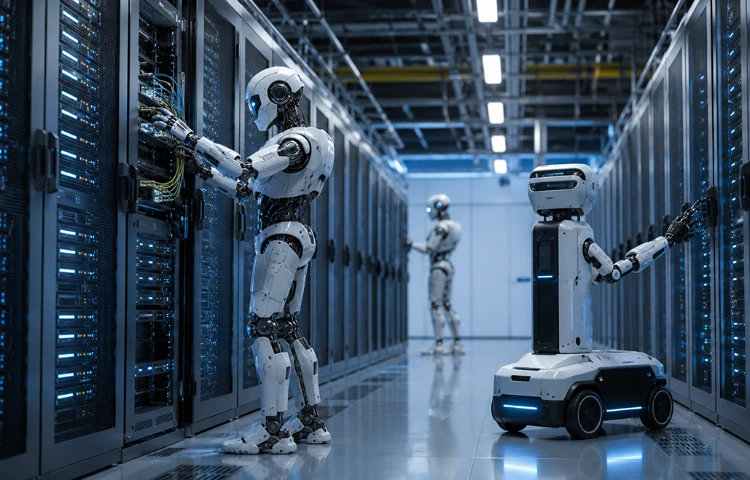
According to a recent WIRED investigation, Meta is testing several robotic systems inside its data centers that could eventually perform tasks ranging from plugging in networking cables and restarting servers to moving equipment and conducting inspections. The experiments offer an intriguing glimpse into the next stage of data center automation, where artificial intelligence is no longer simply running inside the servers—it is beginning to operate the physical infrastructure around them. [WIRED]
For businesses following the development of physical AI, robotics and hyperscale computing, Meta’s experiments matter for a much bigger reason. They could provide an early model for how intelligent machines will be introduced into some of the world’s most valuable and technically demanding workplaces.
Timing is everything.
The AI boom is forcing major technology companies to build computing infrastructure at a scale that would have sounded extravagant only a few years ago. Meta has been aggressively expanding its AI infrastructure, including servers, specialized accelerators and new data centers. In 2026, the company raised its capital-spending outlook to roughly $130 billion to $145 billion as its AI ambitions continued to increase.
Meta itself says that it has broken ground on ten data centers during the previous 24 months as it expands its fleet of AI-optimized facilities. Its useful explainer on how these facilities work provides context for just how much physical infrastructure is required to support seemingly intangible digital services.
The larger the infrastructure footprint becomes, the larger the operational challenge becomes as well.
A hyperscale data center must be monitored constantly. Components fail. Cables loosen. Servers need to be reset. Hardware must be moved. Inventory has to be tracked. Problems can happen at 3 a.m. just as easily as 3 p.m.
That makes data centers an attractive proving ground for robots.
This is not yet a scene from a science-fiction movie where humanoid machines independently run an entire facility.
Meta appears to be taking a more pragmatic approach: automate individual physical tasks where robotics can create measurable operational value.
WIRED reports that Meta has tested technology from Watney Robotics, Kinova and ABB. One experiment involves evaluating whether a Kinova Gen3 robotic arm could perform server power-cycling tasks. Another robotic system is being tested for replacing networking cables. Meta has also deployed simpler mechanisms capable of physically pressing buttons on machines when remotely instructed.
The company already has experience with less sophisticated automation. Meta has used self-driving tugger robots to transport heavy server racks and wheeled robots equipped with barcode readers to help track inventory. Those systems are reportedly operating at multiple Meta data centers, including facilities in Iowa and Virginia.
At Meta’s Altoona, Iowa campus, the company has reportedly been testing two dual-armed Watney robots for cabling work. The machines remain supervised by people and are not yet as fast as human technicians, illustrating an important distinction between an impressive robotics demonstration and a production-ready autonomous workforce.
Meanwhile, Meta is reportedly testing ABB-built mobile robots at its Prometheus data center campus in New Albany, Ohio. These machines combine a wheeled platform, an adjustable lifting mechanism and a robotic arm and are being evaluated for jobs such as reseating components.
The direction is clear: rather than building one magical robot capable of everything, Meta appears to be exploring a collection of robotic systems designed for narrowly defined operational tasks.
Robotic arms have existed for decades. So why is this happening now?
Artificial intelligence is changing what robots can understand and how easily they can adapt.
Traditional industrial robots typically perform carefully programmed motions inside highly structured environments. Modern physical AI systems can combine cameras, sensors, machine learning and increasingly sophisticated reasoning models to understand their surroundings and select actions.
NVIDIA describes this next generation of physical AI as systems that need to perceive the world, reason about what is happening, predict what may happen next and generate an appropriate physical action. Its recent Cosmos 3 work demonstrates how world models are increasingly being designed to support robotics, warehouse automation and other physical-AI applications. [NVIDIA]
There is a catch.
Data centers were designed for people—not robots.
A cable connector that takes an experienced technician seconds to manipulate may be extremely challenging for a robot. Small variations in cable position, resistance, rack design and component layout can create difficult perception and dexterity problems.
WIRED reports that Meta’s existing inventory robot has encountered basic obstacles. Its grayscale camera reportedly cannot distinguish between certain red and green equipment indicators, meaning people are still required for some inspections. The machine can also struggle with corners and cables lying in its path. Battery charging creates additional downtime.
More advanced AI hardware can make the physical challenge even tougher. Dense GPU systems contain enormous amounts of cabling, connectors and tightly packed components. Meta has reportedly acknowledged internally that current robots are not ready for some of the intensive cabling associated with systems such as NVIDIA’s GB300 infrastructure.
This problem is known throughout the robotics industry as the gap between controlled demonstrations and messy reality.
ABB has written extensively about the “sim-to-real” gap—the difficulty of ensuring a robot trained or validated in simulation behaves reliably once it enters a real physical environment. [ABB]
AWS makes a similar argument in its Physical AI Blog. A 2026 simulation-first robotics demonstration showed how organizations can use digital environments to validate automated workflows before deploying them onto physical machines, reducing the cost and risk associated with learning exclusively in the real world.
For Meta, digital twins and high-quality simulation could eventually become nearly as important as the robots themselves.
The most compelling argument for Meta data center robots may not simply be lower labor costs.
It is uptime.
Modern AI infrastructure is enormously expensive. When valuable servers, GPUs or networking systems are unavailable, those assets are not producing useful computing capacity.
Imagine an automated system detecting that a server has stopped responding. Instead of waiting for a technician to receive an alert, travel to the correct building, find the rack and inspect it, a nearby robot could potentially arrive automatically, visually inspect the hardware, perform an approved reset and report the result.
If the problem were more complicated, it could escalate the issue to a human.
That model turns robots into physical extensions of automated infrastructure-management software.
AWS has previously explained how cloud-connected robots can continuously collect operational data, feed monitoring systems, receive updates and interact with other machines and software. That architecture could become particularly valuable in data centers, where practically every physical action can be connected to telemetry and asset-management systems.
The future data-center technician may therefore work alongside a fleet-management platform rather than simply carrying a toolbox.
Moving equipment is comparatively easy.
Manipulating delicate components is where robotics becomes genuinely interesting.
Plugging a cable into the correct port requires perception, positioning, force control and precise hand-eye coordination. A robot has to identify the right connector, align it correctly, apply enough force to make the connection—but not enough to damage expensive equipment—and verify that the task actually succeeded.
Research across physical AI is increasingly focused on solving exactly these kinds of problems.
AWS recently highlighted how robotics developers are training systems using large quantities of real operational data so that machines can perform increasingly dexterous manipulation tasks.
Putting intelligent machines beside multimillion-dollar racks of computing equipment creates another obvious requirement: robots cannot be allowed to improvise recklessly.
A mistaken physical action could disconnect the wrong server, damage networking equipment or interrupt critical infrastructure.
That means physical AI needs multiple layers of safety.
Robots will require collision detection, safe operating zones, authenticated instructions, access controls, detailed activity logs and mechanisms allowing people to stop or override an operation.
NVIDIA’s work on functional safety for robotics demonstrates how seriously the industry is beginning to treat this issue. Its Halos robotics architecture combines hardware and software safety mechanisms designed for autonomous machines working in environments shared with people. [NVIDIA]
Cybersecurity becomes equally important. A robot capable of physically interacting with servers effectively becomes another privileged endpoint on the network. Organizations must determine who can instruct it, what systems it can access, how commands are authenticated and what happens when connectivity is lost.
In other words, the robot may have arms—but enterprises should govern it more like critical infrastructure.
This is likely to become the most closely watched part of Meta’s experiment.
One Meta worker cited by WIRED estimated that a successful cable-swapping robot could potentially replace as much as 80 percent of some workers’ workloads. That is an individual estimate, not a confirmed company projection, and widespread autonomous deployment remains far from guaranteed.
Meta, for its part, argues that it still needs more skilled workers rather than fewer and has launched programs intended to train people for electrical, mechanical and plumbing jobs associated with its infrastructure expansion.
Both developments can be true simultaneously.
Data-center employment may continue growing because the industry itself is expanding rapidly, while the composition of individual jobs changes because robots assume some repetitive tasks.
Technicians may increasingly supervise robotic fleets, perform complicated troubleshooting, maintain automation systems, analyze anomalies and handle tasks machines cannot reliably complete.
The smarter question is therefore not simply, “Will robots take jobs?”
It is: Which tasks will be automated, which jobs will change, and what new skills will workers need?
That distinction is especially important for communities considering subsidies or incentives for massive data-center projects. If employment benefits are part of the public justification for those investments, governments and companies will need increasingly transparent conversations about how automation affects long-term workforce requirements.
Meta’s push to bring robots into data centers is about much more than automating a few repetitive maintenance tasks. It signals a broader shift toward AI-powered infrastructure where software intelligence and physical automation work together to keep critical computing systems running efficiently.
For now, human technicians remain essential. Today’s robots still face real limitations in dexterity, navigation, reliability, safety and their ability to handle unexpected situations. But as physical AI improves, these machines could increasingly take responsibility for routine inspections, hardware movement, cable replacement, server resets and other predictable tasks that currently require manual intervention.
The bigger transformation may come when data centers themselves are redesigned around automation. Robot-friendly racks, standardized connectors, digital twins, autonomous monitoring systems and AI-driven maintenance platforms could dramatically change how future facilities are built and operated.
That makes Meta’s experiments worth watching far beyond the walls of its own data centers. They offer an early look at how robotics could reshape AI infrastructure, workforce skills and enterprise operations across the technology industry.
The irony is hard to miss: AI is creating unprecedented demand for data centers, and AI-powered robots may eventually help maintain the very infrastructure that keeps AI running.
As investment in artificial intelligence continues to accelerate, the next major breakthrough may not simply be a smarter model. It could be a smarter physical environment capable of monitoring, maintaining and increasingly managing itself.









WEBINAR