The race to make smart glasses useful has been a little like trying to make fetch happen. Everyone sees the potential, but the product category keeps wobbling between “cool demo” and “why is there a computer on my face?” Xreal’s Project Aura may be one of the clearest signs yet that the category is maturing.
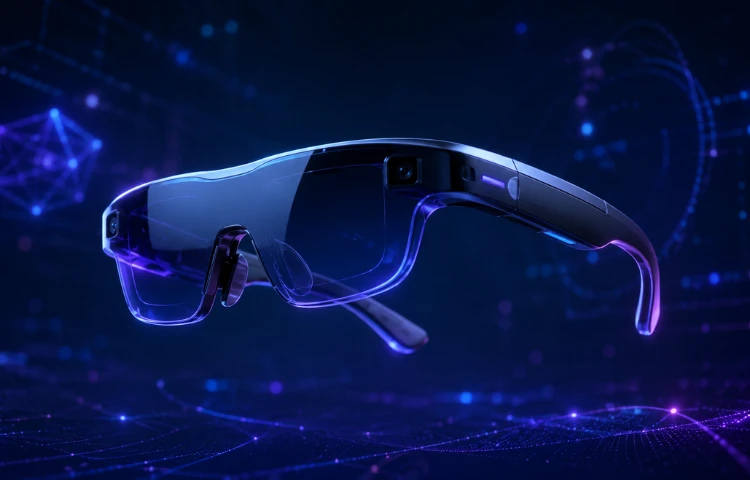
Unveiled at Google I/O 2026, Xreal Project Aura is a pair of tethered XR smart glasses built with Google for Android XR. Xreal says the device features its X1S chip, a 70-degree field of view, optical see-through display technology, and Android XR integration, positioning Aura as a bridge between lightweight AR glasses and full mixed-reality headsets. [Xreal]
Why Project Aura Matters
Most smart glasses today fall into two camps. The first camp is audio-first glasses with cameras and AI assistants. They are light and socially acceptable, but they do not offer a rich visual computing experience. The second camp is full XR headsets, which deliver immersion but are bulky, expensive, and not exactly coffee-shop casual.
Project Aura lands somewhere in the middle. According to hands-on coverage from [Android Central] Aura uses a dedicated compute puck to house processing and battery components, keeping the glasses lighter while still supporting Android XR apps, hand tracking, and immersive spatial experiences.
That design choice matters. It suggests the next wave of XR hardware may not be about cramming everything into the frames immediately. Instead, companies may separate comfort, compute, battery, and display into a more practical wearable system. Elegant? Mostly. Pocketable? Getting there. Better than strapping a toaster to your forehead? Absolutely.
Android XR Finally Has the Hardware It Was Built For
Android XR is Google’s spatial computing platform for headsets and glasses. Project Aura gives that platform a form factor that feels more approachable than a traditional headset. Coverage from [The Verge] describes Aura as sitting between a full headset and lighter mixed-reality glasses, with an interface similar to Samsung’s Android XR experience.
That is the strategic point: Android XR is not just another operating system. It is Google’s attempt to bring Android’s app ecosystem, Gemini AI, spatial interfaces, and developer tooling into wearable computing. If Android made smartphones programmable for the masses, Android XR wants to make the world around you programmable too.
The Big Feature: Immersive Computing Without the Headset Bulk
Project Aura reportedly supports spatial apps, Android apps, hand gestures, cameras, speakers, and immersive display experiences. Gizmodo’s hands-on with [Gizmodo] notes that the glasses felt lightweight and used three cameras, including cameras for hand tracking and capture.
That makes Aura interesting for three practical use cases.
First, productivity. Imagine having multiple virtual screens while traveling, reviewing designs in 3D, or using Gemini to summarize documents in your field of view.
Second, training and simulation. Enterprises could use Android XR glasses for guided workflows, equipment training, maintenance, and field support.
Third, entertainment and media. Spatial YouTube, immersive games, 3D apps, and virtual displays become more compelling when the device is lighter than a headset.
Developers May Be the Real Target Audience
Project Aura is not just a consumer gadget story. It is a developer ecosystem story. According to [9to5Google] Xreal confirmed that Project Aura is expected to launch before the end of 2026, with early access for developers.
That developer focus is smart. The future of XR will not be won by hardware alone. It will be won by apps that make people say, “Oh, I actually need this.” Android XR gives developers a familiar foundation, while Gemini creates opportunities for AI-native experiences: contextual assistants, spatial search, real-time translation, visual guidance, and workflow automation.
The Privacy and Governance Questions Are Not Optional
Any smart glasses with cameras, microphones, AI, and spatial awareness will raise privacy concerns. That is not a footnote; it is the product category’s central challenge.
Wearable AI can see what the user sees. That makes it powerful for accessibility, translation, field service, and productivity. It also makes consent, data retention, bystander privacy, enterprise security, and regulatory compliance unavoidable. In the workplace, this becomes even more complex. Are meetings being recorded? Are customers aware? Where is spatial data stored? Can employees opt out?
The takeaway: Project Aura’s success will depend not only on field of view and battery life, but also on trust. In XR, “move fast and break things” is not a product strategy. It is a compliance headache wearing sunglasses.
Final Takeaway
Xreal Project Aura looks like an important step toward making Android XR smart glasses more practical, developer-friendly, and enterprise-relevant. It combines lightweight glasses, a compute puck, Android XR, Gemini-powered possibilities, hand tracking, and immersive visual experiences into a package that feels closer to everyday spatial computing than many previous attempts.
The big question is not whether Project Aura is cool. It is. The bigger question is whether developers, enterprises, and consumers will find enough real-world value to make XR glasses part of daily work and life.
For now, Project Aura feels like a preview of where computing is going: less screen-hopping, more context, more spatial interfaces, and more AI woven into the real world. The future may not be a giant headset after all. It may be a pair of glasses, a puck, and an assistant that finally knows what you are looking at—hopefully with excellent privacy settings.