At an age when many teenagers are still deciding which subjects they enjoy most, Canadian student Evan Budz has built something that could reshape aquatic environmental monitoring: an autonomous, AI-powered robot turtle capable of detecting microplastics directly in water.
Budz, now 16, was 15 when his invention earned one of the top honors at the 2026 Regeneron International Science and Engineering Fair. His project combines biomimetic robotics, artificial intelligence and underwater holographic imaging in a single mobile platform.
The result is not merely an eye-catching science-fair prototype. It is an early demonstration of how intelligent, nature-inspired machines could help researchers monitor lakes, rivers and oceans more efficiently.
According to a detailed [Business Insider profile of Evan Budz and his robot turtle] the young inventor spent roughly 2,000 hours developing the robotic platform and another 2,000 hours building its specialized holographic camera. That is an extraordinary amount of testing, programming and engineering—especially for a project that began with a robot that initially sank “like a brick.”
From a Snapping Turtle to a Bionic Underwater Robot
The idea began during a family camping trip in Ontario.
Budz watched a snapping turtle move smoothly through the water and became fascinated by its efficient, fluid swimming motion. Unlike conventional underwater vehicles, which frequently rely on rapidly spinning propellers, turtles propel themselves using controlled movements of their limbs.
That observation led Budz to ask a deceptively simple question: Could a robot move like a turtle while carrying technology that monitors environmental threats?
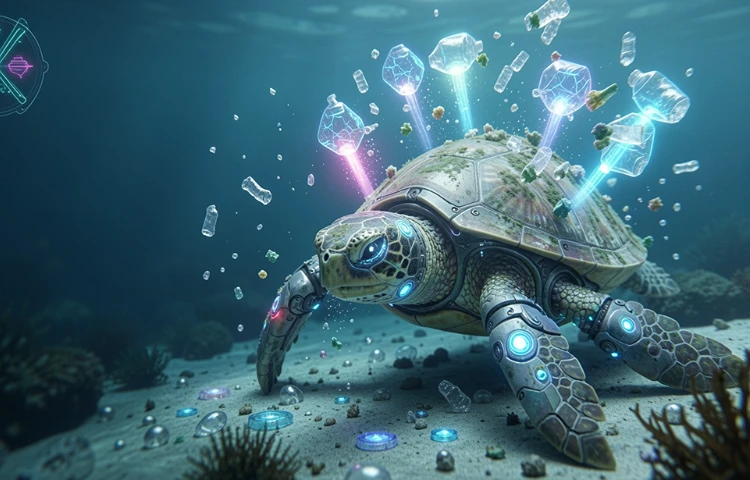
His answer became a bionic underwater robotic turtle, commonly referred to as BURT.
The robot uses four flipper-like limbs to move and stabilize itself. Its turtle-inspired shape provides enough internal and external space to hold cameras, sensors, computing equipment and other scientific payloads. Its biomimetic movement may also be less disruptive than some traditional underwater vehicles, particularly in sensitive environments where noise, propeller wash and abrupt motion could disturb wildlife.
A [Popular Science feature about BURT] explains that the platform was designed not only to investigate microplastics, but also to recognize environmental conditions such as coral bleaching and invasive species. During simulated coral-reef testing, an earlier version reportedly identified replicated coral bleaching with 96% accuracy. That figure is separate from the robot’s reported 94% accuracy in distinguishing microplastics from other particles.
How the AI-Powered Robot Turtle Works
BURT is autonomous, meaning it does not need to be steered continuously by a person.
Budz developed algorithms that allow the robot to follow predefined search patterns, regulate its depth and navigate to locations selected by an operator. This gives it an important advantage over tethered underwater equipment, which may be restricted by cable length, currents or obstacles.
As the robot travels through the water, its imaging system collects information about suspended particles. A small onboard computer processes navigation and sensor data, while trained AI models help classify what the camera sees.
The system’s most innovative component is its underwater three-dimensional holographic camera.
Unlike an ordinary camera, which captures a flat image of an object, digital holographic imaging records patterns created as light interacts with particles. Software can then reconstruct information about those particles, including characteristics that may be difficult to observe through conventional photography.
Budz’s AI models analyze these reconstructed images and attempt to distinguish pieces of plastic from microorganisms, sediment and other naturally occurring material.
The official [Society for Science coverage of the 2026 Regeneron ISEF awards] reports that the models achieved 94% accuracy in separating microplastics from other particles. Budz tested the system in 10 bodies of water and examined more than 80,000 three-dimensional images containing plastic particles and microorganisms. The system was designed to identify pieces of plastic smaller than a red blood cell.
Why Microplastics Are So Difficult to Monitor
Microplastics are generally defined as plastic fragments measuring less than five millimeters. Some are deliberately manufactured at a small size, while others form when larger plastic products gradually break down.
According to the [National Oceanic and Atmospheric Administration’s microplastics explainer] these particles can originate from degraded plastic debris, industrial resin pellets and manufactured microbeads. They can enter oceans, rivers and the Great Lakes, where aquatic organisms may mistake them for food.
Finding microplastics is far more complicated than spotting a floating bottle.
A single water sample may contain sediment, algae, plankton, fibers and countless organic particles. Researchers must determine which particles are plastic, measure their sizes and, in some studies, identify their polymer composition.
Traditional analysis may involve collecting samples in the field, transporting them to a laboratory, filtering the water, chemically preparing the material and examining suspected particles using microscopy or spectroscopy. These methods can be accurate, but they often require expensive instruments, trained specialists and considerable processing time.
Differences in sampling equipment, particle-size thresholds and analytical methods can also make it difficult to compare results from different locations.
BURT addresses part of this problem by bringing the imaging system to the water instead of requiring every initial observation to begin in a distant laboratory.
Why Holographic Imaging and AI Are a Powerful Combination
Artificial intelligence is particularly useful when researchers must classify thousands—or potentially millions—of complex images.
Instead of asking a person to inspect every particle individually, a machine-learning model can be trained using examples of known microplastics and non-plastic materials. Once trained, the model searches new images for patterns associated with each category.
Holographic imaging adds another layer of information. It can capture particles across a three-dimensional volume rather than focusing on only one narrow plane. This makes it possible to analyze more suspended material while preserving information about particle shape, structure and movement.
Detection Is Not the Same as Removal
It is important to describe the invention accurately: BURT detects and measures suspected microplastics; it does not currently remove them from the water.
That distinction matters because pollution management has several separate stages:
- Determining where pollution is present
- Measuring its concentration and distribution
- Identifying likely sources
- Evaluating risks to ecosystems
- Designing prevention, treatment or removal strategies
Reliable detection makes the remaining stages more effective.
A robot that maps microplastic concentrations across a lake, reservoir or coastal zone could help researchers find pollution hotspots. Authorities could then investigate nearby wastewater systems, industrial facilities, stormwater outlets, shipping activity or heavily used recreational areas.
Repeated surveys could also reveal whether pollution levels are rising, falling or moving with seasonal currents.
BURT therefore should not be viewed as a robotic vacuum cleaner for the ocean. Its potential value lies in generating better environmental data—something policymakers, scientists and conservation groups need before choosing where to intervene.
Responsible AI Matters Underwater Too
Environmental AI should be transparent, testable and accountable.
Whenever an AI system produces measurements that may influence public policy, conservation funding or pollution enforcement, users need to understand how those results were generated. A single accuracy percentage does not tell the whole story.
Future versions of the system should document:
- The kinds of particles included in the training dataset
- The environments in which the robot was tested
- The smallest particle sizes it can identify reliably
- Its performance across different plastic types
- How uncertain classifications are reported
- How results compare with laboratory-confirmed samples
Ecological impact must also remain part of the design process. A robot intended to protect aquatic environments should not introduce unnecessary noise, shed materials, disturb animals or damage habitats.
BURT’s turtle-inspired locomotion is promising in this respect, but long-term field studies would still be needed to confirm its behavior around wildlife.
A Major Achievement for a Teenage Inventor
Budz’s work earned him the Gordon E. Moore Award for Positive Outcomes for Future Generations and a $50,000 scholarship at the 2026 Regeneron International Science and Engineering Fair.
The award recognizes research with the potential to create lasting benefits through rigorous science and engineering. Budz competed at an event involving more than 1,700 students from around the world, making the recognition especially significant.
The story is also a powerful lesson in persistence.
Early versions of the robot failed to swim correctly. Budz had to solve problems involving buoyancy, depth control, mechanical movement, imaging resolution and machine-learning accuracy. Outdoor testing was further limited by Canada’s cold winters.
Instead of treating those failures as proof that the idea would not work, he used them as engineering data.
That mindset may be the project’s most valuable takeaway for young innovators: groundbreaking technology rarely arrives fully formed. It develops through repeated testing, failed prototypes, uncomfortable questions and patient refinement.
Conclusion
This AI-powered robot turtle is more than a clever science project. It is a strong example of what can happen when curiosity, persistence, robotics and environmental responsibility come together.
By combining autonomous navigation, holographic imaging and machine learning, Evan Budz has created a tool that could make microplastic monitoring faster, more mobile and more accessible. The technology still needs broader testing and real-world validation, but its potential is clear: better data can lead to better decisions about where pollution is coming from and how to reduce it.
Perhaps the most inspiring part of the story is not the robot itself, but the person behind it. Budz’s first prototype failed. Instead of stopping, he learned from it, rebuilt it and kept experimenting. That willingness to keep going turned a difficult idea into an award-winning innovation.
The future of environmental monitoring may involve fleets of intelligent machines working quietly beneath the surface. And one of the first steps toward that future may have started with a teenager, a turtle-inspired design and a robot that refused to stay sunk.