

Prefer to listen instead? Here’s the podcast version of this article.
Scrolling through TikTok has always been a dangerous activity for your wallet. One minute, you’re watching a cooking tutorial. The next, you’re convinced you need a $200 espresso machine. Now, TikTok wants to make that journey from “I want it” to “I bought it” faster than ever.
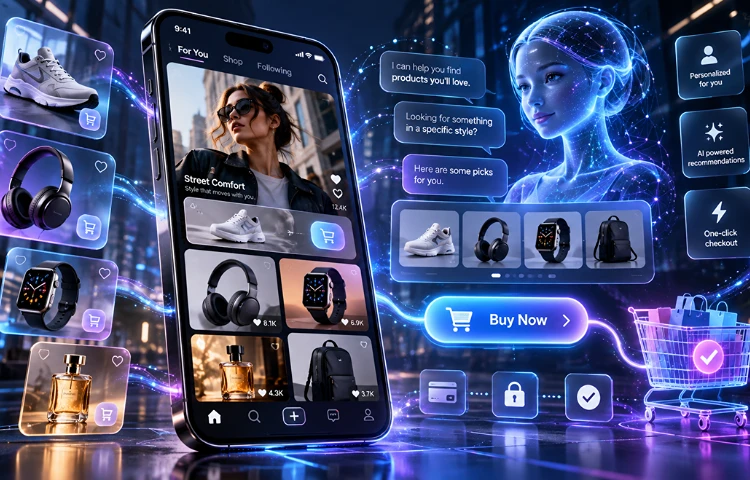
TikTok announced two major eCommerce innovations: an AI-powered Shopping Assistant and Buy Direct, a one-click checkout solution that lets consumers purchase products directly from brands without leaving the platform.
Unveiled during Advertising Week New York, these developments represent a significant step toward agentic commerce, where artificial intelligence doesn’t simply recommend products but actively helps shoppers navigate purchasing decisions.
For retailers, digital marketers, and eCommerce businesses, TikTok’s latest move raises a compelling question: What happens when social media becomes your personal shopping assistant, product researcher, and checkout counter—all in one?
Let’s explore how TikTok’s new AI shopping tools work, why they matter, and what businesses should do to prepare.
TikTok’s new Shopping Assistant is designed to make online shopping more conversational, personalized, and convenient.
Rather than requiring users to open multiple websites, search for product specifications, compare prices manually, or contact sellers, the AI-powered assistant provides answers within TikTok’s shopping experience.
According to [Tiktok’s official blog] Shopping Assistant uses merchant-provided product information to help consumers get answers while browsing product pages through TikTok’s in-app browser.
Imagine watching a video featuring a pair of running shoes. Instead of leaving TikTok to research the product, you could ask the assistant:
The assistant is designed to interpret conversational context and remember shoppers’ needs throughout their interactions, making the buying process more intuitive.
Unlike traditional keyword-based search, conversational AI allows shoppers to express preferences naturally. Someone could ask for lightweight hiking boots suitable for wet conditions rather than typing several disconnected search terms.
The result is potentially a more useful shopping experience that reduces uncertainty at the moment of purchase.
However, the quality of the experience depends heavily on the accuracy and completeness of information supplied by merchants. AI can streamline product research, but it cannot replace accurate inventory, sizing information, and clearly communicated product policies.
The second major innovation is Buy Direct, TikTok’s one-click checkout solution.
Traditionally, social media shopping involves several stages. A consumer discovers a product in a video, clicks an advertisement, visits a retailer’s website, adds the product to a cart, enters payment information, and finally completes the transaction.
Every additional step introduces an opportunity for distraction or cart abandonment.
TikTok’s Buy Direct aims to shorten this journey by enabling purchases directly from the For You feed.
As [TechCrunch] the combination of conversational shopping assistance and integrated checkout could help TikTok retain more of the consumer purchasing journey within its ecosystem.
TikTok explains that Buy Direct supports stored payment methods, saved delivery addresses, and in-app order tracking. Participating brands remain the merchant of record.
These capabilities may deliver several benefits:
The important distinction is that TikTok’s Shopping Assistant and Buy Direct support different stages of the journey. The assistant provides guidance, while Buy Direct handles native checkout. Shopping Assistant can also direct shoppers to a merchant’s website within TikTok’s browser.
As of October 8, 2026, these solutions are available through eligibility-based testing opportunities rather than universally across all TikTok accounts.
TikTok has spent years establishing itself as a major product discovery platform. Its recommendation algorithms expose consumers to products through entertaining videos, creator demonstrations, reviews, and targeted advertisements.
The introduction of conversational AI adds a new layer: decision-making support.
In its October 7 analysis [Retail Dive]
This evolution matters because social commerce is moving beyond attracting attention toward helping customers complete transactions within the same environment.
The potential commercial opportunity is considerable.
According to figures highlighted in TikTok’s October 2026 announcement, its Economic Impact Report found that activity on the platform helped generate $81 billion in GDP for U.S. businesses. The report also found that 54 million Americans had purchased a product after watching a TikTok video.
These statistics are not measurements of the newly introduced Shopping Assistant or Buy Direct. Instead, they illustrate the existing scale of TikTok-influenced consumer activity.
For marketers, the implications are substantial. Video content may increasingly function as both a promotional asset and the beginning of an AI-guided purchasing experience.
A successful TikTok campaign may need to do more than attract views. It must deliver useful product information, demonstrate genuine value, and answer the questions shoppers ask before making a purchasing decision.
TikTok’s strategy reflects a broader technology movement known as agentic commerce.
Agentic commerce involves AI systems that help consumers discover products, evaluate options, and participate in purchasing workflows. Depending on their design and permissions, these systems may also perform certain transaction-related actions.
TikTok is collaborating with commerce and payment technology companies including Shopify, Salesforce, Shoplazza, and Stripe to support its new shopping experiences.
Its official product documentation identifies the Universal Commerce Protocol (UCP) as an integration requirement for Buy Direct.
These integrations matter because intelligent shopping experiences rely on far more than a conversational interface. They require dependable connections among product catalogs, inventory systems, payment infrastructure, fulfillment services, and customer records.
For a deeper understanding of the technology powering this transition [Stripe] explains how AI-enabled commerce introduces new requirements for secure payment permissions, merchant control, and transaction authorization.
Stripe describes payment technologies that allow authorized agents to participate in transactions without exposing underlying payment credentials.
Although Stripe’s broader agentic commerce infrastructure should not be confused with the exact implementation of TikTok’s checkout, it demonstrates how payment providers are preparing for AI-mediated purchasing.
The shift is significant: an online storefront is no longer necessarily the only place where customers discover and purchase a company’s products.
For businesses, TikTok’s announcement should be viewed as an opportunity to rethink the entire digital customer journey.
An AI shopping assistant is only as useful as the product information it can access.
Brands should prioritize complete descriptions, accurate specifications, clear size charts, updated availability, transparent shipping policies, and straightforward return information.
This is particularly important when AI answers depend on merchant-supplied data.
A product page with detailed, structured information is better positioned to support accurate conversational responses than one with vague marketing language.
TikTok videos have traditionally focused on visibility, engagement, and entertainment.
Those elements still matter, but marketers should also consider how content answers specific purchasing questions.
Product demonstrations, comparison videos, authentic customer feedback, and practical tutorials can help consumers understand why a product meets their needs.
If checkout occurs directly within a social platform, businesses must evaluate more than website traffic.
Relevant performance indicators may include product engagement, shopping assistant interactions, add-to-cart activity, completed purchases, average order value, and return rates.
Brands should also distinguish between purchases attributable to a creator’s content and incremental sales actually generated by an advertising campaign.
Faster checkout is useful, but sustainable growth depends on profitable conversions, not simply more transactions.
Consumers are becoming accustomed to asking AI tools questions in natural language.
That expectation could influence how brands design eCommerce websites, support systems, recommendation engines, and customer service workflows.
Businesses investing in conversational AI should focus on accurate responses, simple escalation to human support, and reliable connections to operational systems.
The objective is not to replace every customer interaction with automation. It is to make useful information easier to access.
While AI-assisted commerce offers convenience, it also introduces important responsibilities.
A shopping assistant that remembers consumer preferences can deliver relevant recommendations. But personalization should not come at the expense of privacy, transparency, or customer choice.
In its October 6 coverage [TechRepublic] examines the new shopping tools and their advertiser-testing availability, providing additional context for brands evaluating these emerging capabilities.
As such systems evolve, businesses should pay close attention to five considerations.
Data privacy: Customers should understand what information is collected, how it is used, and what controls are available.
Recommendation transparency: AI-generated shopping advice should not mislead users about product quality, suitability, pricing, or commercial relationships.
Purchase authorization: Automated assistance must respect the difference between recommending a product and receiving permission to purchase it.
Accuracy: Product availability, shipping estimates, and prices should be validated against reliable merchant systems.
Fair treatment: Recommendation systems should be assessed for misleading outcomes, unfair discrimination, and inappropriate commercial influence.
These considerations are especially important as regulatory expectations for AI transparency, consumer protection, and data handling continue evolving across jurisdictions.
For businesses, responsible AI should be embedded into product design, governance, and ongoing monitoring rather than introduced only after problems appear.
TikTok’s Shopping Assistant and Buy Direct are part of a larger change in how consumers interact with digital commerce.
Shopping may increasingly begin with a video, continue through an AI conversation, and end with an integrated checkout experience.
Over time, retailers could expand conversational interfaces to support personalized product comparisons, replenishment suggestions, multilingual assistance, and post-purchase services.
However, these possibilities should not be mistaken for confirmed features of TikTok’s initial rollout.
The immediate priority for businesses is preparation.
Retailers should strengthen product data quality, assess commerce integration requirements, improve short-form video content, and establish responsible AI practices.
Brands interested in participating in TikTok’s new solutions should also review eligibility requirements through their TikTok advertising representatives.
The companies that benefit most from this transition are unlikely to be those that simply add the most AI features. They will be those that combine convenient technology with trustworthy product information and genuinely useful customer experiences.
TikTok’s introduction of an AI Shopping Assistant and one-click checkout marks a significant step toward a faster, smarter, and more personalized online shopping experience. By combining conversational AI, intelligent product discovery, and simplified checkout, TikTok is transforming how consumers interact with brands and make purchasing decisions.
For businesses, this evolution presents exciting opportunities to improve customer engagement, reduce purchasing friction, and increase conversion rates. As AI-powered social commerce continues to grow, brands that invest in accurate product information, personalized customer experiences, and seamless shopping technologies will be better positioned to stay competitive.
However, the future of AI-driven shopping isn’t just about convenience. Data privacy, transparency, secure transactions, and responsible AI implementation will remain essential to building long-term consumer trust.











WEBINAR