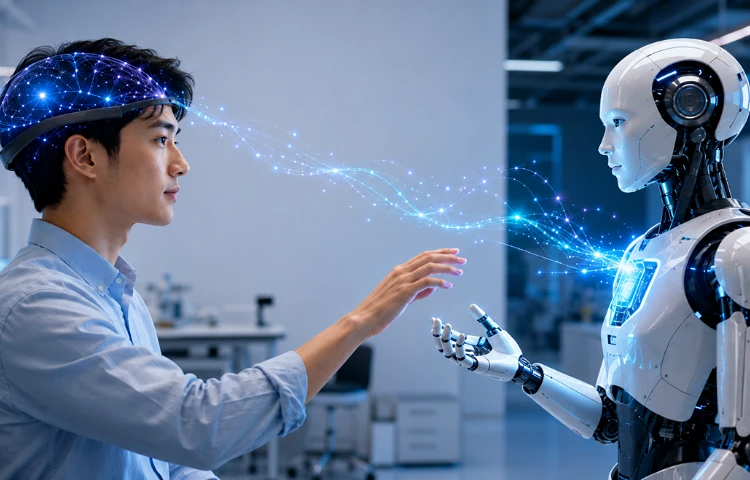
Controlling a robot with your thoughts sounds like something borrowed from a science-fiction movie. Chinese neurotechnology company BrainCo, however, is attempting to turn that idea into a practical research tool.
At the 2026 World Artificial Intelligence Conference in Shanghai, BrainCo demonstrated a new platform that connects a non-invasive electroencephalography headset to robotic systems. The BrainCo brain-to-robot interface captures electrical activity from a user’s scalp, applies artificial intelligence to identify patterns associated with specific intentions, and converts those patterns into instructions that a robot can execute.
Coverage from [TechRadar] describes the system as an integrated brain-controlled robot AI platform intended to make thought-based robot control more accessible to researchers and developers. It is an exciting milestone—but it is not quite telepathy, and the word “first” requires some context.
How the BrainCo Brain-to-Robot Interface Works
The platform has three main layers: an EEG sensing system, AI-powered software and a robotic execution device.
1. EEG Sensors Capture Brain Activity
The user wears a non-invasive EEG headset containing electrodes that detect tiny electrical signals produced by brain activity. Because the electrodes sit on the scalp, no surgery or implanted device is required.
Non-invasive EEG is generally more affordable and portable than implanted brain-computer interfaces. The trade-off is that scalp-based signals are weaker and noisier. Eye movements, muscle activity, poor electrode contact and environmental interference can all affect the data.
2. Software Cleans and Interprets the Signals
Raw EEG does not arrive as a neat instruction saying, “Move the robotic arm to the left.”
The software must filter noise, identify relevant features and compare the resulting signal patterns with data associated with known tasks. Depending on the experiment, a user might focus on a visual stimulus, imagine moving a hand or generate another deliberately trained mental response.
Machine-learning models then classify the detected pattern and estimate the user’s intended command.
3. Intent Is Mapped to a Robot Command
Once an intention has been identified, the platform translates it into an instruction the connected robot understands. A classified signal might correspond to selecting an object, moving forward, stopping, turning, opening a robotic hand or initiating a predefined task.
According to [Gasgoo’s detailed report on the BrainCo platform] the software includes preconfigured brain-computer interface experiments and neural-decoding algorithms. BrainCo says this could allow researchers without extensive BCI programming experience to establish basic robot control in approximately ten minutes. That figure should be understood as the company’s setup goal, not proof that every person can master unrestricted robot control in ten minutes.
4. The Robot Acts and Provides Feedback
The connected machine performs the selected action, and the user observes the result. That feedback creates a loop: the person adjusts their concentration or intention while the system continues collecting information that may improve future decoding.
BrainCo says its platform can connect with several kinds of machines, including robotic arms, humanoid robots and robot dogs. [TechNode’s coverage of the WAIC demonstration] also reports that the platform is intended to generate data for training future human-robot interaction systems.
No, It Does Not Read Every Thought in Your Head
“Controlling robots with your thoughts” is a catchy description. It can also create an exaggerated impression of what the system does.
The platform does not appear to interpret a person’s unrestricted inner monologue. It is not listening while someone mentally debates lunch options and accidentally ordering a robot to make noodles.
Current non-invasive BCI systems generally recognize a limited collection of trained or experimentally induced signal patterns. The user and system may require calibration, repeated trials and clearly defined commands. The robot may also provide a level of autonomy after receiving a high-level instruction rather than relying on the user to mentally control every motor movement.
This distinction matters. Recognizing one of several intended commands is a very different technical challenge from reconstructing complex language, memories or private thoughts.
Why BrainCo’s Platform Could Be Important
The most valuable feature may not be the headline-friendly thought control. It may be the platform’s ability to lower the development barrier for brain-robot research.
Historically, a team building a brain-controlled robotic system might need separate expertise in neuroscience, EEG hardware, signal processing, machine learning, robotics, experimental design and embedded systems. Every integration layer introduces extra cost and additional opportunities for failure.
By placing more of that workflow inside one platform, BrainCo could help researchers prototype ideas faster, compare decoding methods and test the same interface across multiple robotic devices.
Potential Applications of Thought-Controlled Robots
Assistive Technology and Rehabilitation
The most compelling applications are likely to involve people who cannot reliably use conventional controllers because of paralysis, limb differences, neuromuscular conditions or serious injuries.
A brain-controlled interface could allow a user to operate an assistive robotic arm, mobility device, computer or prosthetic system through intentionally generated neural signals. For some users, even a small number of dependable commands—select, stop, move, confirm or call for assistance—could increase independence.
BrainCo already develops bionic hands and related human-machine-interface products, giving the company experience at the intersection of neural signals and physical movement. However, the newly demonstrated research platform should not automatically be treated as a clinically validated medical product. Medical applications would require controlled studies, appropriate regulatory review and evidence that the system is safe and beneficial for its intended population.
Industrial and Hazardous Environments
Workers could eventually use brain signals as an additional control channel while supervising robots in factories, mines, disaster areas or environments involving hazardous materials.
A technician whose hands are occupied might use a deliberate mental command to pause a machine or select a robotic action. A human operator could also provide high-level guidance while an autonomous robot handles navigation, balance and fine motor control.
That does not mean brain interfaces will replace control panels tomorrow. In safety-critical environments, they are more likely to supplement physical controls than eliminate them.
Training Data for Embodied AI
BrainCo’s system could also help researchers study how humans communicate intention to machines.
Combining neural signals with video, eye tracking, robot telemetry and task outcomes could create useful datasets for human-robot interaction. Researchers may be able to examine when a person intends to intervene, recognizes an error or becomes uncertain.
This could eventually produce robots that respond not only to explicit commands but also to signs of hesitation or cognitive overload. Such capabilities would need careful boundaries: a machine that recognizes when its operator is confused may be helpful, while a workplace system continuously evaluating employees’ mental states could quickly become invasive.
Neural Privacy Is No Longer a Theoretical Issue
EEG recordings are not ordinary usage analytics. Even when a system is designed for simple commands, neural data may reveal or allow inferences about attention, fatigue, emotional responses, health conditions or other personal characteristics.
Important governance questions include who owns the recordings, where they are processed, how long they are retained, whether they can be reused for model training and whether third parties can access inferred information.
In November 2025, UNESCO adopted the first global normative framework focused specifically on neurotechnology ethics. Its [Recommendation on the Ethics of Neurotechnology] emphasizes mental privacy, autonomy, protection of neural data and safeguards against manipulation or coercion. These principles are directly relevant to any commercial brain-to-robot system.
Consent must also be meaningful. An employee should not be pressured into wearing a neural sensor simply because refusing could harm their career. Similarly, schools, insurers and employers should not treat uncertain brain-signal interpretations as objective measurements of attention, honesty, productivity or ability.
Safety, Cybersecurity and Human Control
Connecting a neural interface to a physical robot creates a long chain of potential failure points: sensor errors, corrupted data, inaccurate AI classification, network delays, software bugs and mechanical faults.
The system should therefore include confidence thresholds, restricted command sets, emergency stops, collision avoidance and clear human override procedures. High-risk actions should require additional confirmation rather than being triggered by one ambiguous neural pattern.
Cybersecurity is equally important. Brain data must be protected in storage and transmission, while robot commands must be authenticated to prevent unauthorized control. Organizations should also maintain logs showing what the system detected, which command was generated and why the machine acted.
What Businesses and Research Teams Should Do Next
Organizations interested in brain-controlled robotics should begin with tightly limited pilot projects rather than dramatic, company-wide deployments.
A responsible evaluation should define the exact task, intended users, acceptable error rate and conditions under which the robot must stop. Teams should test the system with a representative user group and document differences in calibration time, comfort and accuracy.
Neural data should be collected only when necessary, protected with strong access controls and deleted according to a published retention schedule. Participants should know whether their raw signals or inferred mental states will be used to train future models.
Organizations should also establish responsibility across the entire system. When a command is misinterpreted, accountability cannot disappear into the gap between the headset company, AI developer, robot manufacturer and system integrator.
The Future of the BrainCo Brain-to-Robot Interface
BrainCo’s platform does not mean that general-purpose robots can now understand any thought, perform any task or operate without errors.
What it may provide is a more accessible foundation for developing and comparing brain-controlled robotic systems. That could accelerate research in assistive technology, rehabilitation, industrial robotics, human-machine collaboration and embodied AI.
The next milestones will be less flashy but more meaningful: independent performance evaluations, larger user studies, published error rates, clearer neural-data policies and successful operation outside controlled demonstrations.
BrainCo has brought the brain-to-robot interface closer to a standardized development product. Whether that product becomes a transformative accessibility tool, an important research platform or simply an impressive demonstration will depend on what happens after the conference lights switch off.
One thing is certain: the future of human-robot interaction may involve more than keyboards, touchscreens and voice assistants. Our machines are beginning to respond to neural intent—and that makes responsible design just as important as technical ambition.