
Prefer to listen instead? Here’s the podcast version of this article.
Artificial intelligence has already transformed how we write, code, analyze information, and solve complex business problems. Now, it is preparing to tackle something considerably smaller than a smartphone screen but infinitely more mysterious: the fundamental particles that make up our universe.
The European Organization for Nuclear Research (CERN) and French artificial intelligence company Mistral AI announced a strategic partnership to develop an advanced AI foundation model for particle physics.
According to [CERN] the collaboration will combine CERN’s expertise in high-energy physics and scientific computing with Mistral’s experience in training advanced AI systems.
The initiative centers on a proposed Large Physics Model, identified as Flare in [Reuters]
Unlike conventional AI chatbots trained primarily to understand and generate language, Flare is intended to learn from billions of simulated particle collisions.
Its mission? Help physicists process complex experimental information, recognize important patterns, and potentially uncover signals that traditional analytical methods might overlook.
The partnership represents an important development in AI for scientific discovery, but it also raises questions about accuracy, transparency, research infrastructure, and responsible deployment.
Flare is the name reported for CERN and Mistral’s proposed Large Physics Model, a foundation model specifically designed for collider physics.
A foundation model is an AI system pretrained on extensive datasets so its learned representations can support multiple related tasks. While a large language model develops statistical representations of text and other information, a physics foundation model can learn patterns in scientific measurements and simulations.
CERN’s approach is particularly ambitious because particle physics requires scientists to interpret complicated interactions involving enormous quantities of detector information.
When particles collide inside the Large Hadron Collider (LHC), their interactions produce signals that sophisticated detectors record. Scientists must reconstruct these signals to determine which particles were produced, how they behaved, and what the events reveal about physical laws.
Today, researchers typically use specialized algorithms across different stages of this process.
Flare aims to create a more unified approach, potentially supporting several reconstruction and analysis tasks through one pretrained model.
The proposed system is expected to assist with particle identification, collision reconstruction, unexpected-signal detection, and the evaluation of future detector designs.
Importantly, the announcement is a statement of intent. Flare should not yet be considered a completed or scientifically validated AI system. Neither a confirmed launch date nor a project budget has been publicly disclosed.
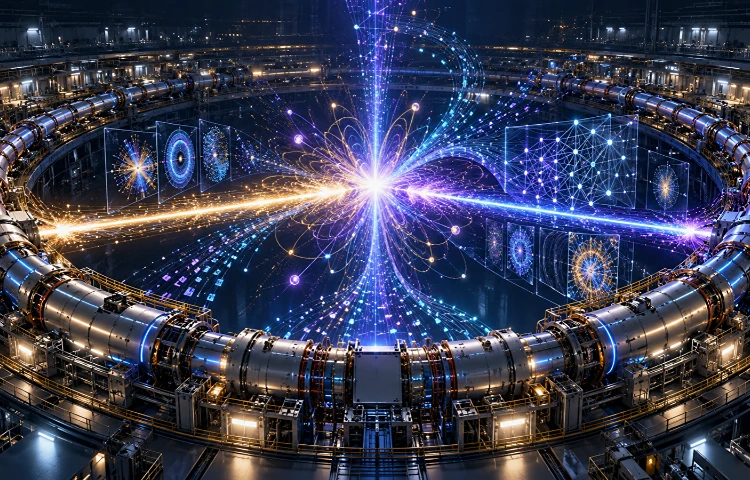
CERN operates the Large Hadron Collider, the world’s largest and most powerful particle accelerator.
The LHC generates particle collisions that allow scientists to investigate fundamental questions about matter, energy, and the universe.
The challenge is that modern particle physics experiments generate extraordinary volumes of information.
CERN reports that approximately one exabyte of experimental data, equivalent to one million terabytes, has already been stored from the LHC.
Now imagine analyzing that information while preparing for significantly more collisions.
That is precisely the challenge facing researchers.
The High-Luminosity Large Hadron Collider (HL-LHC) upgrade is expected to increase collision volumes dramatically. CERN anticipates approximately ten times as many collisions once the upgraded facility enters operation around 2030.
A September 2026 [ScienceDaily] explains how more powerful superconducting magnets will help focus particle beams more tightly, creating more opportunities for collisions.
This makes improvements in data processing especially important.
Traditional particle reconstruction uses multiple algorithms to transform detector signals into scientifically meaningful descriptions of collision events.
These algorithms are highly specialized and carefully tested. However, coordinating numerous components can become increasingly computationally demanding as the complexity and volume of data grow.
A foundation model could potentially simplify portions of this workflow by learning relationships across several reconstruction stages.
Instead of developing entirely separate AI tools for every analytical problem, researchers could adapt a common pretrained model to different scientific tasks.
The goal is not to eliminate established physics methods. It is to combine the strengths of machine learning with the precision and reliability of conventional scientific analysis.
The CERN and Mistral partnership has the potential to influence several important areas of particle physics.
Particle identification involves determining which particles produced particular signals inside a detector.
Different particles interact with detector materials in different ways. Scientists use these interactions, along with reconstructed trajectories and energy measurements, to classify the particles involved.
Flare could learn complex relationships among detector measurements and help identify particles more efficiently.
If successful, this capability could improve reconstruction workflows and potentially strengthen the quality of subsequent scientific analyses.
However, any performance improvement would need to be demonstrated through rigorous comparisons with established methods.
Collision reconstruction transforms raw detector signals into a structured representation of what happened during a particle interaction.
This process requires interpreting tracking information, energy deposits, and other measurements while accounting for detector behavior and experimental uncertainty.
Flare’s proposed unified architecture could help researchers analyze relationships among these signals across multiple reconstruction stages.
A more integrated approach might reduce duplicated computation and enable researchers to explore alternative reconstruction methods.
These possibilities remain research objectives rather than confirmed performance gains.
One of the most exciting possibilities is anomaly detection.
In particle physics, some discoveries begin with evidence that does not fit established expectations.
An AI model trained on large collections of simulated collision events might learn patterns representing expected behavior. Researchers could then investigate unusual deviations that deserve closer attention.
Such systems could help scientists prioritize interesting events or identify subtle signals that are difficult to recognize using existing techniques.
However, unusual data does not automatically mean new physics.
Detector imperfections, statistical fluctuations, or simulation inaccuracies can also produce unexpected results.
Any potentially important finding would still require independent scientific verification.
Flare could also contribute to the design and evaluation of future experimental detectors.
Researchers must make complicated decisions about detector geometry, materials, measurement precision, and computing requirements.
AI models capable of learning from particle simulations could help scientists compare potential detector configurations and identify promising design choices.
This would not replace detailed detector simulations or engineering tests. Instead, AI could become an additional tool for evaluating design alternatives before committing to expensive physical infrastructure.
Mistral has become a significant European developer of advanced AI models, with an emphasis on customizable systems and enterprise applications.
Its interest in physics-focused AI also predates the CERN announcement.
In May 2026, Mistral published [Minstral] explaining how AI systems trained on physics-related data can help engineers evaluate complex physical behavior more quickly.
The company described applications involving aerodynamics, heat transfer, structural analysis, manufacturing, and industrial engineering.
Mistral also expanded its physics capabilities through its acquisition of Emmi AI, a company specializing in AI-assisted engineering simulations.
This background is particularly relevant because both industrial engineering and particle physics involve complicated numerical models, large computational workloads, and demanding accuracy requirements.
Still, there is an important distinction.
An AI model trained to predict airflow around an aircraft is not automatically capable of reconstructing particle collisions.
The underlying data, scientific objectives, model architectures, and evaluation methods can differ substantially.
Mistral’s broader experience is valuable, but Flare will require physics-specific research and testing.
The company’s publication [Physics AI Research That’s Shaping the Industry] offers additional insight into its work on neural surrogate models, computational fluid dynamics, and advanced physics modeling.
These research directions demonstrate why domain-specific foundation models are attracting attention across scientific and engineering industries.
One promising aspect of Flare is the possibility of creating reusable AI capabilities for researchers working on related particle physics problems.
Scientists currently invest substantial time developing, maintaining, and validating specialized computational tools.
A shared foundation model could potentially provide a common starting point for multiple research activities.
This approach might benefit large international scientific collaborations by making advanced analytical capabilities easier to reuse.
It could also help smaller research groups access techniques that would otherwise require substantial development resources, provided the necessary models, computing infrastructure, and documentation are made available.
However, accessibility depends on more than creating a powerful model.
Researchers also need clear documentation, suitable deployment infrastructure, reproducible training and evaluation methods, and practical opportunities to inspect scientific results.
Although the partnership is promising, building a trustworthy AI foundation model for particle physics involves several difficult technical challenges.
Particle physics demands exceptionally high precision.
An AI system that performs well on average may still introduce unacceptable errors in rare or scientifically important events.
Researchers will need to evaluate how reliably Flare reconstructs particles, handles uncertainty, and performs across different experimental conditions.
Benchmarking against established reconstruction methods will be essential.
Flare is expected to be pretrained on billions of simulated proton-proton collisions.
Simulation provides a valuable environment for model development because researchers can study known physical processes under controlled conditions.
However, simulated detector responses never perfectly reproduce every detail of real experimental measurements.
Differences between simulated and observed data can affect model accuracy.
Flare will therefore need careful validation using real detector measurements, including situations that differ from its training examples.
A scientifically useful AI prediction must be more than convincing.
Researchers need to understand how a result was generated, how uncertainty was assessed, and whether other teams can reproduce the finding.
This creates important requirements for model documentation, version tracking, training-data provenance, and independent evaluation.
Without these safeguards, AI could accelerate the production of results without improving scientific confidence.
Large-scale AI training can require substantial computational resources and energy.
A successful physics foundation model should therefore be evaluated not only on predictive accuracy but also on computational efficiency.
For example, does the model reduce the total resources required for reconstruction? Does its training cost justify the benefits across multiple research tasks?
These questions matter because sustainable scientific computing is increasingly important as experimental datasets expand.
The CERN–Mistral collaboration also illustrates the growing strategic importance of European AI research.
CERN brings decades of international scientific collaboration, while Mistral contributes expertise in advanced AI development and deployment.
Together, they could help strengthen Europe’s capabilities in scientific computing and domain-specific AI.
But technological leadership must be accompanied by responsible governance.
Scientific AI systems should support transparency, reproducibility, appropriate human oversight, and independent scrutiny.
For Flare, this could involve documented evaluation benchmarks, scientifically meaningful uncertainty estimates, and clear procedures for detecting model failures.
Another important question concerns openness.
Mistral is known for developing open-weight AI models, but that does not establish that Flare’s weights, training datasets, or complete development methods will be publicly released.
The partners have emphasized the ambition to create capabilities that can benefit the wider physics community, yet the precise distribution and access arrangements remain to be determined.
Although CERN and Mistral are beginning with collider physics, the research could generate insights useful in other scientific fields.
Foundation models that learn from complex physical systems may eventually support applications in materials research, energy systems, environmental modeling, and advanced engineering.
For example, techniques developed to analyze large experimental datasets might inspire better methods for interpreting scientific measurements in other disciplines.
Similarly, improvements in uncertainty estimation or scientific model validation could benefit researchers developing AI tools for different physical systems.
This does not mean Flare itself will immediately work across every scientific field. Different domains require specialized data, appropriate model designs, and extensive testing.
The broader opportunity is to advance methods for building trustworthy, reusable AI models that operate on scientific information rather than everyday language.
The announcement establishes a strategic direction, but several important details remain open.
Researchers and industry observers will be watching for information about Flare’s underlying architecture, training methodology, deployment strategy, and scientific evaluation results.
Future milestones could include research prototypes, experimental benchmarks, comparisons with conventional reconstruction methods, and details about how the broader physics community may access the system.
The central measure of success will not be model size or the number of simulated collisions processed during training.
It will be whether Flare delivers reliable, reproducible improvements in meaningful scientific tasks.
For physicists, that may mean improved reconstruction quality, more effective anomaly detection, or better support for detector development.
For the AI industry, it could demonstrate how foundation models can be adapted to highly specialized scientific problems.
And for research institutions, it may provide another example of how collaboration between scientific laboratories and AI developers can expand the possibilities of computational research.
The partnership between CERN and Mistral AI to develop Flare marks an exciting step toward integrating artificial intelligence into advanced scientific research. By combining CERN’s expertise in particle physics with Mistral’s advanced AI capabilities, this initiative could transform how scientists analyze complex collision data, identify unusual patterns, and explore the fundamental mysteries of the universe.
More than just another AI breakthrough, Flare represents the growing potential of AI foundation models for scientific discovery. Its proposed capabilities in particle identification, collision reconstruction, and anomaly detection could help researchers process enormous datasets more efficiently while supporting the next generation of experiments at the Large Hadron Collider.
However, the success of Flare will depend on scientific accuracy, transparency, responsible AI development, and rigorous validation. As AI becomes increasingly integrated into research environments, maintaining human oversight and ensuring trustworthy results will remain essential.
The implications could eventually extend beyond particle physics, inspiring advances in engineering, materials science, energy research, and other data-intensive scientific fields.
The future of AI isn’t just about machines understanding human language; it’s also about helping humanity better understand the universe. With Flare, CERN and Mistral are taking an ambitious step toward that future.










WEBINAR