

Prefer to listen instead? Here’s the podcast version of this article.
Artificial intelligence has spent the past few years living mostly in the cloud. Ghost wants to give it a permanent address in your home.
San Francisco startup Ghost, led by 19-year-old founder and CEO Zain Javaid, emerged from stealth with an $11 million seed round and an unusually ambitious product: Core, a $3,499 personal AI computer designed specifically for continuously running AI agents.
According to [TechCrunch] the investment was led by Andreessen Horowitz, with participation from Abstract, Audacious Ventures, SV Angel and Nova. Javaid’s founding team includes Nicholas Chua, 19, Yifei Chen, 24, and Gautam Sharda, 23.
The headline-grabbing part is Javaid’s age. The more important technology story, however, is Ghost’s attempt to redefine what a personal computer looks like when AI agents, rather than applications, become the center of the computing experience.
That makes Core much more interesting than another expensive PC in a sleek box.
Javaid originally imagined a future in quantitative finance, using mathematics and data to guide investment decisions. The release of ChatGPT in 2022 changed that trajectory. He became interested in personal AI and eventually turned that interest into Ghost.
That origin story matters because Ghost is not positioning Core as a faster way to open spreadsheets, browse websites or run traditional desktop software. Instead, the company is starting with the assumption that tomorrow’s computer will need to understand its owner continuously.
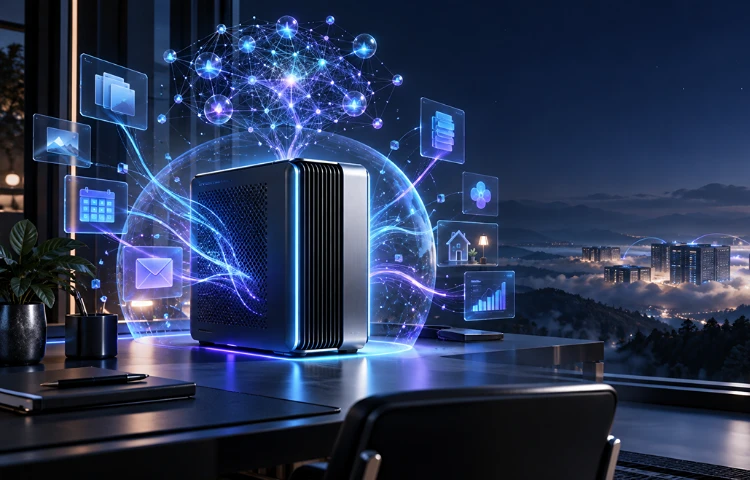
Ghost calls Core a personal AI computer. Javaid has described the concept as a kind of “brain in a box”: a dedicated machine that can connect to files, applications and other devices, build an evolving understanding of a user’s life and allow AI agents to perform tasks on the user’s behalf.
Core does not look like the traditional definition of a personal computer because it does not need its own screen. Users interact with the system through Ghost’s companion software, including a phone or computer.
The company’s current [Ghost] lists the device at $3,499, with no required subscription. Ghost says Core runs its AI models locally and continuously builds context from information the user chooses to connect.
The hardware is substantial.
Core currently lists an NVIDIA RTX PRO 4000 Blackwell SFF Edition GPU with 24 GB of GDDR7 ECC memory, an AMD Ryzen 5 7600 six-core processor, 64 GB of DDR5 system memory, and a 1 TB NVMe SSD. NVIDIA itself positions the RTX PRO 4000 SFF as a compact professional GPU capable of AI inference and edge-AI workloads, with up to 770 theoretical AI TOPS under the manufacturer’s specified conditions.
That configuration helps explain why Core costs considerably more than an ordinary mini PC. Ghost is not merely selling a lightweight client that sends prompts to a remote AI service. It is selling the computational hardware required to run substantial models locally.
An independent overview from [CellCog] also examines the device’s hardware, funding and local-AI positioning, while [ExplainX] places the product within the growing market for on-device personal AI.
The big caveat is equally important: early specifications tell us what hardware is inside the box, not how good the overall experience will be. Independent, long-term benchmarks of Core’s agent reliability, responsiveness and everyday usefulness remain far more important than raw specifications.
Today’s generative AI assistants are usually prompt-driven. You ask something, the model responds, and you repeat the process.
Ghost is pursuing something much more persistent.
Core is designed to connect with information such as files, calendars, browser activity, email, wearables and compatible smart-home devices. Ghost’s vision is that continuously accumulated context will allow an agent to understand patterns rather than isolated prompts.
Instead of being told every morning to inspect a calendar, an AI could already understand the day’s schedule. Instead of repeatedly explaining preferred routines, projects or priorities, the system could retain relevant context. Instead of responding only after being summoned, the agent could surface useful information proactively.
That is a significant shift from AI as a tool toward AI as an ongoing computational layer surrounding the user.
Google is exploring a related challenge from a different architectural direction. In its [DeepMind] Google describes the growing importance of persistent personal AI context while attempting to preserve privacy through protected cloud infrastructure. Google’s approach demonstrates why memory has become such a critical frontier: useful personal AI increasingly needs continuity, not merely intelligence within one conversation.
Ghost’s differentiation is straightforward. Rather than making secure cloud memory the center of the architecture, it wants the user’s own computer to become the center.
The irony of personal AI is that the better an assistant understands someone, the more sensitive the information required to make it useful can become.
Calendars reveal relationships and routines. Email contains private communication. Browser activity can reveal interests and intentions. Connected devices can expose behavior inside the home. Wearables may contain deeply personal fitness and health information.
An AI that combines these sources can be extraordinarily useful, but it also creates a remarkably concentrated data profile.
That is why Ghost’s local-first architecture matters.
The company says conversations, memories and connected content used by Core’s local intelligence remain on the device. Its privacy policy also says Ghost does not maintain a cloud backup of Core’s conversations, files or memories and does not use that content for AI training.
The phrase “on-device,” however, should not be interpreted as meaning that Core never communicates with the internet. Ghost’s own privacy documentation explains that online features can still communicate with external services. Email access, web searches, third-party applications, remote access and similar functions naturally require network communication. The meaningful distinction is that Core’s conversational model and memory processing can remain local, rather than automatically sending the user’s personal knowledge base to a remote AI model.
That nuance matters. As [TechRadar] privacy needs to be treated as an architectural requirement rather than a feature added after an AI device reaches the market.
For a device built around intimate, persistent context, trust is not a bonus feature. It is part of the product.
Local processing solves only part of the challenge.
An agent becomes significantly more useful when it can take actions. That also means the agent may eventually receive access to accounts, credentials, files and connected services.
An assistant capable of reading a calendar is useful. An agent capable of changing that calendar is more powerful. An agent that can operate across email, applications, connected devices and online accounts has significantly broader authority.
That makes permission design crucial.
Javaid told TechCrunch that Ghost is developing a firewall intended to monitor outbound network requests and restrict agents from using credentials or transmitting information in ways the system considers unauthorized. Users are also expected to control how much autonomy their agents receive.
These safeguards will be central to Core’s success because the AI industry’s next challenge is no longer simply producing accurate text. It is building systems that can take useful actions while remaining bounded, observable and accountable.
Ghost is also making a larger bet about the future of computing interfaces.
Traditional computing revolves around applications. Users open a program, locate information, make decisions and perform an action.
Agentic computing could compress much of that process.
A user describes an objective, while software determines which applications, files and services are required to complete it. Applications still exist underneath, but the AI agent increasingly becomes the interface through which users coordinate them.
Core takes this idea further by designing the computer itself around that relationship.
Javaid has contrasted Core with systems such as the Mac Mini. A conventional desktop can certainly be configured to run local AI models, but it remains a general-purpose machine. Ghost wants to integrate the models, memory layer, agent software, browser, file system and local hardware into one purpose-built experience.
In other words, Ghost is not arguing that existing computers cannot run AI.
It is arguing that running an AI model and owning a computer built around a persistent AI agent are two different product experiences.
Core’s biggest immediate obstacle is obvious: $3,499 is expensive.
That price puts it firmly in enthusiast, developer, professional and premium-workstation territory rather than mass-market consumer electronics.
Ghost partly offsets the sticker shock with a no-subscription positioning. A sufficiently expensive cloud AI plan used over several years can accumulate meaningful costs, while local inference gives owners direct control over their compute hardware.
There are also users for whom privacy or local ownership may carry significant value: developers experimenting with agents, professionals working with sensitive information, AI enthusiasts, researchers and users who simply prefer running models without depending entirely on a cloud provider.
Still, hardware economics move quickly. GPUs become faster. Smaller AI models become more capable. Quantization reduces memory requirements. Competition brings down prices.
The long-term opportunity for Ghost may therefore be larger than the first $3,499 machine. Core could serve as a high-end starting point for a category that eventually becomes cheaper and more mainstream.
Personal computing has followed that pattern before.
Personal AI machines create responsibilities that go beyond conventional PC design.
If systems continuously analyze communications, behavior, device activity and other personal information, users need clear controls over what is collected, how long it is retained, what the AI infers and which actions it can perform.
Transparency also matters when AI-generated memories are wrong. Ghost’s privacy policy acknowledges that generated memories may be inaccurate and provides controls intended to let users review, correct or remove them.
This is exactly where the personal-AI race could be won or lost.
The most capable assistant will not necessarily be the system with access to the largest model. It may be the system that creates the best combination of intelligence, privacy, user control, security and transparency.
As regulators and industry groups develop standards for trustworthy AI, manufacturers building persistent personal agents will increasingly need to demonstrate not only what their systems can do, but also how those systems behave when given access to sensitive data and permission to act.
The ambition behind Core is substantial, but this remains an early product from a young startup.
Hardware specifications alone will not determine whether it succeeds.
Ghost needs to prove that local models can deliver consistently useful performance, that continuous context produces meaningful improvements rather than notification overload, that agents can take actions reliably, that permission controls remain understandable, and that the privacy architecture works as advertised under real-world scrutiny.
Independent testing will be particularly important. Early reporting and Ghost’s own documentation provide a detailed picture of the intended product, but broad third-party evidence about long-term performance, security and reliability is still limited.
That distinction should remain clear.
Core is not yet proof that the personal-computer industry has found its post-PC future.
It is evidence that serious founders and investors believe AI-native personal computing is now worth building from the hardware upward.
A 19-year-old raising $11 million makes for an irresistible startup headline.
The more consequential development may be what Ghost represents.
For years, the dominant AI experience has been straightforward: open a website or application, send information to a remote model, receive an answer and close the window.
Ghost imagines something fundamentally different.
Your AI runs continuously. It develops memory. It understands your selected digital context. It can interact with the tools around you. Its intelligence lives on hardware you own.
Whether Core itself becomes a breakout product remains to be seen, but its underlying philosophy points toward an important transition from cloud-only AI assistants to persistent, locally controlled AI agents.
If that model works, the next personal-computing battle may not revolve around the best laptop, operating system or smartphone.
It may revolve around who builds the AI that knows enough to be genuinely useful while remaining trustworthy enough to deserve that knowledge.
Ghost’s $11 million funding round and its $3,499 Core personal AI computer represent more than an impressive startup milestone for 19-year-old founder Zain Javaid. They highlight a broader shift in artificial intelligence toward personal, persistent, and locally controlled AI systems that can understand context, retain memory, and assist users across everyday digital tasks.
The promise is compelling. By combining powerful local hardware with AI agents, persistent memory, and privacy-focused processing, Ghost is betting that the next generation of computing will be built around intelligent assistants rather than traditional applications. At the same time, the company will need to prove that Core can deliver reliable performance, meaningful automation, strong security, and transparent user controls in real-world environments.
The $3,499 price means Core will initially appeal most to developers, AI enthusiasts, researchers, and professionals who value local computing and greater control over their data. However, if hardware costs continue to decline and smaller AI models become more capable, technologies like Core could eventually influence a much broader consumer market.
Ultimately, Ghost is testing a powerful idea: the future of personal computing may not be defined simply by faster processors or better screens, but by AI systems that understand users while keeping them in control of their information. Whether Ghost becomes the company that leads that transformation remains uncertain, but its arrival signals that personal AI hardware is quickly becoming a serious new frontier in the technology industry.











WEBINAR