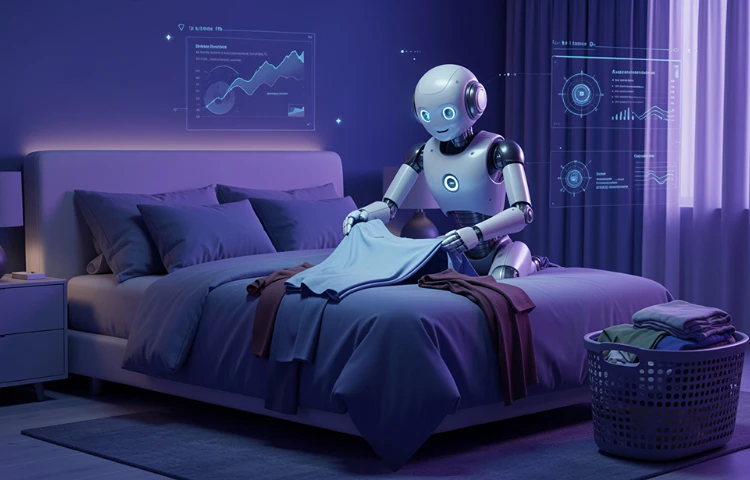
Folding laundry is one of those chores that looks simple—right up until you try teaching a robot to do it.
A shirt can be crumpled, upside down, partially inside out, hidden beneath another garment or made from fabric that stretches whenever it is picked up. Every home has different furniture, lighting, floor plans and laundry habits. In robotics terms, your innocent-looking laundry basket is basically a chaos generator with sleeves.
Sunday Robotics now says it has made a major breakthrough in solving that problem.
The California robotics startup reports that its wheeled home robot, Memo, can use a new artificial intelligence model called ACT-2 to fold garments it has never encountered before in homes where it has never operated. According to the company’s detailed [ACT-2 technical preview] Memo achieved a 99.1% success rate across 785 autonomous folding attempts involving nine major garment categories.
That is an impressive result. It may also represent an important step toward home robots that can adapt to real environments instead of performing carefully rehearsed tricks in carefully staged demonstration rooms.
Still, it is important to underline one word: Sunday says it achieved these results. The tests, scoring system and published analysis come from the company itself and have not yet been independently replicated.
What Did Sunday Robotics Actually Demonstrate?
Sunday’s claim goes beyond showing Memo folding one familiar T-shirt on a laboratory table.
The company says the robot was evaluated using clothing that had not been used for task-specific training and in homes that were excluded from the model’s post-training process. The same model checkpoint and robot configuration were reportedly used throughout the evaluation, with no additional demonstrations, fine-tuning or home-specific adaptation.
The test included T-shirts, shorts, pants, leggings, blouses, polo shirts, sleeveless tops and both thick and lightweight long-sleeved garments. Clothing sizes reportedly ranged from XXS to 8XL, while fabrics varied in color, material, thickness and texture.
Memo also had to work with clothes presented in different starting positions. Garments could be naturally crumpled in a pile, placed in a basket on a bed, left in a basket on the floor or positioned at different angles. The robot operated from the left, right or foot of a bed under varying lighting conditions and against different sheet colors.
Across 785 attempts, Sunday recorded 778 successful folds. The company says completed folds received an average quality score of 4.72 out of five, with 98.3% receiving four or five stars. Successful folds took a median of approximately two minutes and 13 seconds per garment. Blouses proved the most difficult category, although Memo still reportedly achieved a 94.7% success rate with them.
Additional reporting from [Business Insider] highlights that Sunday Robotics tested Memo not only in controlled environments but also in employee homes and rental properties. This approach was designed to evaluate whether improvements developed in the company’s lab could transfer effectively into unfamiliar real-world settings.
Why Folding Unseen Clothes Is So Difficult
Traditional factory robots are extremely reliable because their worlds are deliberately predictable. The same component arrives in the same position, the lighting remains controlled and the robot repeats an identical movement thousands of times.
Homes are the opposite.
A household robot must work around furniture, changing light, pets, children, reflective surfaces and objects that may appear anywhere. Clothing adds another layer of complexity because fabric is deformable. A robot cannot assume that a sleeve, collar or waistband will remain in one fixed position after the garment is moved.
To fold a shirt successfully, the robot must first identify what it is looking at. It must estimate the garment’s shape, choose useful grasping points, lift the fabric without losing control, separate overlapping sections, align the edges and preserve the fold while placing the item onto a stack.
One poor grip can change the entire shape of the garment and make the robot’s original plan useless.
Earlier research demonstrates how hard this has been. Systems such as SpeedFolding achieved meaningful progress with unseen garments, but researchers often worked with specialized tabletop setups and more controlled operating conditions. Sunday is attempting to move that kind of manipulation into ordinary homes using a mobile, general-purpose machine.
How ACT-2 Learns to Perform Household Tasks
ACT-2 is designed around a combination of broad pretraining and focused post-training.
Sunday collects demonstrations from humans performing physical tasks while using sensor-equipped hardware designed to mirror the movements of Memo’s hands. These demonstrations give the model examples of how people grasp, reposition and manipulate objects.
The system is then refined using data collected from Sunday’s internal robot fleet. When a robot makes a mistake, researchers can capture a successful recovery or corrective behavior and use that example to improve the model.
Sunday argues that the strength of ACT-2’s underlying pretrained model allows a small number of high-quality examples to produce improvements that transfer to new objects and environments. In other words, the company does not want to retrain Memo separately for every customer’s bedroom, laundry basket or collection of concert T-shirts.
This training challenge extends across the robotics industry. A useful [Washington Post examination of household-robot training data] explains how companies are gathering human demonstrations, first-person videos and robot-teleoperation data to teach machines how physical tasks are performed. Unlike language models, robots cannot simply learn everything they need from books and websites. They require data connecting visual observations to physical movements—and that data is expensive and difficult to collect.
Why “Zero-Shot” Generalization Matters
The most significant part of Sunday’s announcement is not the folding itself. Robots have folded clothing before.
The important part is the claim that ACT-2 can maintain high performance without receiving new training data from each home.
In this context, “zero-shot” does not mean the robot has never learned anything about clothing. ACT-2 was trained using broad human and robotic task data. It means the deployed model did not receive garment-specific or home-specific training before being evaluated in the new environment.
That distinction matters commercially.
A home robot that requires technicians to collect demonstrations and fine-tune its software every time it enters a new house would be expensive and difficult to scale. A robot that can arrive with a pretrained set of transferable skills has a far more plausible path toward mass deployment.
Sunday’s “Solve” Standard Could Be as Important as the Robot
Robotics videos are entertaining, but they are not always informative.
A polished clip might show a robot successfully performing a task without revealing how many failed attempts came first, whether a human operator intervened or whether the environment was specifically arranged to make the demonstration easier.
To address that problem, Sunday has proposed a measurement framework it calls a Solve. Under this framework, a robotics capability should be described using three elements:
- Performance: How accurately, quickly and consistently the robot completes the task.
- Scope: Which objects, environments and starting conditions are covered by the claim.
- Adaptation cost: How much additional data, training, intervention or system modification is needed for each deployment.
The idea is refreshingly practical. Saying a robot achieved “99% success” means little without knowing whether it folded one type of shirt in one laboratory or hundreds of different garments across unfamiliar rooms.
Sunday’s declared scope also reveals important limitations. Its evaluation excluded socks, underwear, bras and accessories. Memo folded individual garments, but this is not the same as completing the entire laundry process. Collecting dirty clothes, sorting them by fabric and color, operating a washer and dryer, identifying stains, pairing socks and putting everything into drawers remain separate challenges.
The machine has conquered part of Mount Laundry. The sock-pairing summit remains unconquered.
How Does Memo Compare With Other Home Robots?
Sunday is entering an increasingly crowded home-robotics race.
LG, SwitchBot, 1X, Tesla and Weave Robotics have all presented machines intended to perform household or human-scale tasks. Yet demonstrations at technology events frequently occur under controlled conditions.
In [The Verge’s hands-on examination of laundry robots at CES 2026] reporters explored whether the latest household robots could move beyond impressive stage demonstrations and function reliably in actual homes. The testing highlighted a central industry tension: Should companies develop expensive general-purpose robots, or focus on specialized devices that perform one narrow task extremely well?
Sunday is betting that generalization can make a multipurpose robot practical. Memo’s wheeled body can reposition itself, change its working height and use two arms to manipulate household objects. Sunday has previously shown earlier versions of its technology clearing tables, loading dishwashers and preparing espresso.
However, the company acknowledges that capabilities such as vacuuming, organizing toys, fastening zippers and making coffee are not yet reliable enough for broad deployment. Laundry folding is being presented as the first task that has reached its proposed Solve threshold.
Privacy and Safety Will Determine Whether People Welcome Robots Home
A robot operating in a bedroom or living room may rely on cameras, microphones, depth sensors and network connections. That creates privacy concerns very different from those associated with an industrial robot operating inside a restricted factory.
Consumers will need clear answers to several questions:
What information does the robot record? Is video processed on the device or sent to the cloud? How long is data retained? Can a remote operator see inside the home? How are software updates secured? What happens when the robot encounters a child, pet, fragile object or unexpected obstacle?
Sunday says Memo will operate autonomously during its planned beta deployment, with remote assistance available when customers request help. The company has also said it does not plan to use those customer-home interventions as training data. Those are encouraging commitments, but meaningful trust will require transparent policies, technical safeguards and auditable controls—not simply reassuring promises.
What Sunday Robotics’ Breakthrough Could Mean
Sunday’s announcement does not mean a flawless robotic housekeeper is about to appear in every home.
It does suggest that robotics may be moving from one-off demonstrations toward systems that can transfer skills across messy, unpredictable environments. If ACT-2’s results are independently reproduced—and if Sunday can maintain similar reliability during extended customer use—the achievement would represent a meaningful advance in robotic generalization.
The larger opportunity extends well beyond folding shirts. The same approach could eventually help robots adapt to elder-care environments, hospitality operations, healthcare facilities, warehouses and other spaces where objects and layouts constantly change.
For businesses, the lesson is not to purchase the flashiest robot available. It is to identify repetitive, measurable tasks; define acceptable performance and safety boundaries; test systems under realistic conditions; and account for the human support required when automation fails.
For consumers, the winning home robot will not be the one that looks most like science fiction. It will be the one that quietly completes useful work, protects household data, behaves safely and does not require an engineering degree to operate.
Sunday Robotics may not have solved all of laundry. But it may have shown how adaptable robots can begin turning familiar chores into measurable, repeatable capabilities.
And honestly, any machine willing to deal with the fitted sheet deserves at least a polite round of applause.