

Prefer to listen instead? Here’s the podcast version of this article.
Apple’s WWDC26 was not just another software showcase. It was Apple’s clearest signal yet that artificial intelligence is becoming the operating layer of its ecosystem. The company previewed the next generation of Apple Intelligence, introduced Siri AI, expanded parental controls, and announced major improvements across iOS 27, iPadOS 27, macOS 27, watchOS 27, visionOS 27, and tvOS 27. Apple framed the update around privacy, usefulness, safety, and everyday productivity rather than AI-for-AI’s-sake hype.
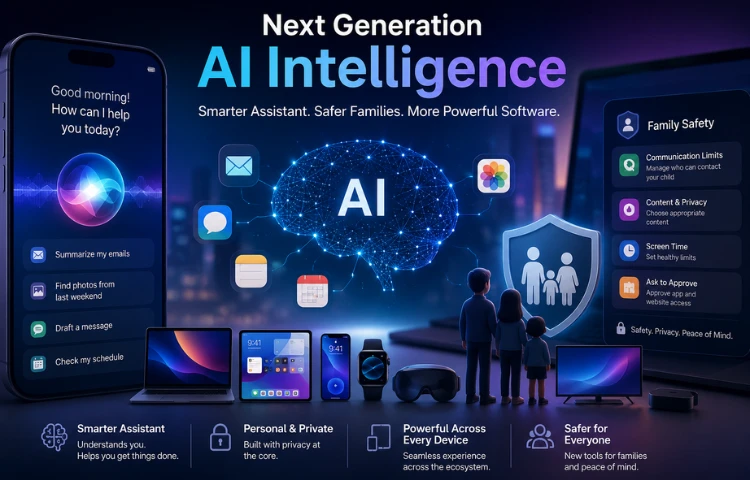
The headline announcement is Siri AI, described by Apple as an entirely new version of Siri. Unlike the older assistant, Siri AI is designed to understand what is on your screen, use personal context across apps, search messages, emails, photos, and more, and complete actions across the system. In plain English, Siri is moving from “set a timer” territory into “help me get this done” territory.
A major usability shift is the new dedicated Siri app, which lets users revisit past conversations or begin new ones from one place. Apple says the conversation history syncs privately across devices using iCloud, making Siri AI feel less like a one-off voice command tool and more like a persistent personal assistant. For deeper technical context, Apple’s developer session on Siri AI highlights conversational prompts, image transformation, writing help, password updates, and privacy safeguards.
External coverage also shows how big this pivot is. The Verge’s WWDC26 Siri AI analysis notes that Siri AI can work systemwide, interact with apps, read onscreen context, and use Apple’s Private Cloud Compute for cloud-based requests. That matters because Apple is trying to compete with chatbot-style assistants while preserving its privacy-first positioning. [The Verge]
The next generation of Apple Intelligence is not limited to Siri. Apple says it will power improvements in Photos, Safari, Image Playground, Messages, Mail, and other everyday apps. That is the smart play: instead of making users “go to AI,” Apple is embedding AI into tasks people already do — editing images, writing messages, organizing browser tabs, improving photos, and managing information.
For users, this means fewer context switches. Safari can become more organized, Photos gains smarter editing capabilities, and Image Playground gets broader creative use cases. Ubergizmo’s breakdown of Siri AI adds useful detail on the redesigned interface, Dynamic Island access, deeper app actions, Vision Pro support, and a dedicated camera-based Siri mode. [Ubergizmo]
One of the most important WWDC26 announcements is Apple’s expanded family safety toolkit. Apple previewed features that let parents manage what children can see, who they can communicate with, and when they can access apps. New tools include simpler child account setup, recommended essential apps, Ask to Browse, Time Allowances, and a redesigned Screen Time experience.
The new Ask to Browse feature is especially relevant for families. It allows parents to require approval before a child visits a new website in Safari, similar in spirit to Ask to Buy for App Store purchases. Communication controls also let parents manage who children can contact through Messages, FaceTime, and Phone. Apple says Communication Safety will also expand to intervene when gore or violent content is detected in shared images or videos.
This is not just a feature update; it is a trust update. The Guardian’s WWDC26 report highlights Apple’s focus on child safety, including safer child accounts, limits on content, communication management, browsing permissions, and simplified screen-time tools. For parents, schools, and family-focused app developers, this may be one of the most immediately useful announcements from the event. [The Guardian]
WWDC26 also matters for developers because Apple is giving them more tools to build age-appropriate experiences. Apple says developers can use tools such as SensitiveContentAnalysis, PermissionKit, and the Declared Age Range API to help tailor app experiences while protecting a child’s privacy. The important detail: age-range sharing is designed without revealing the child’s actual birthday.
This creates a new standard for responsible app design. Apps will be expected to think more carefully about age-appropriate content, consent, communication, and safety-by-default experiences. For businesses building iOS apps, the takeaway is simple: privacy, child safety, and AI transparency are no longer “nice to have.” They are becoming platform expectations.
Siri AI will be available as a beta later this year for supported devices set to English, with more languages expected later. Apple also says availability will vary by region. Siri AI will not initially be available in the EU on iOS, iPadOS, and watchOS, and Apple Intelligence features will not be available in China while Apple works through regulatory requirements.
TechCrunch’s WWDC26 recap is a helpful external read for the broader announcement set, especially Apple’s parental-control push and how the new tools fit into the company’s larger software roadmap. Business Insider’s Siri AI coverage also adds useful context on the standalone Siri app, English-first rollout, device limitations, and Apple’s Google collaboration. [Business Insider]
WWDC26 marks a strategic reset for Apple. The company is not simply adding AI features; it is trying to make AI feel native, private, and useful across the full Apple ecosystem. Siri AI is the most visible piece, but the deeper story is how Apple Intelligence is being woven into apps, family safety, productivity, creativity, and developer workflows.
For everyday users, the promise is less friction. For parents, it is more control and confidence. For developers, it is a new wave of platform capabilities and safety expectations. For businesses, it is a reminder that the next generation of digital products will be judged not only by how intelligent they are, but by how trustworthy, accessible, and responsibly designed they feel.
WWDC26 may be remembered as the year Apple stopped treating AI as a feature category and started turning it into the interface layer of its ecosystem.
WWDC26 makes one thing clear: Apple is moving into a more intelligent, privacy-focused, and family-conscious era of computing. With the next generation of Apple Intelligence, the long-awaited evolution of Siri AI, stronger parental controls, and wide-ranging software updates across its ecosystem, Apple is positioning AI as a practical everyday assistant rather than a flashy add-on.
For users, this means devices that better understand context, simplify tasks, and offer more personalized support. For parents, it means stronger tools to guide children’s digital experiences with greater confidence. For developers and businesses, it signals a future where privacy, safety, and intelligent automation are central to building successful digital products.
Ultimately, WWDC26 is not just about new features. It is about Apple reshaping how people interact with technology — making devices more helpful, more protective, and more deeply integrated into daily life. As Apple Intelligence continues to expand, the real opportunity will be creating experiences that are not only smarter, but also safer, more human, and genuinely useful.











WEBINAR
