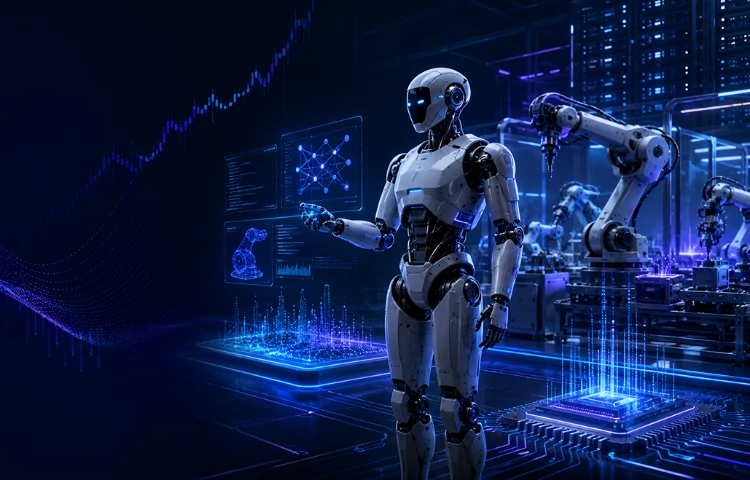
Nvidia has already become one of the defining companies of the generative AI boom. Now it wants artificial intelligence to leave the screen, grow arms and legs, and start interacting with the physical world.
That ambition is becoming increasingly important to the Nvidia investment story.
Nvidia shares traded around $225 as investors digested another expansion of the company’s robotics strategy. Barron’s reported that the stock had gained more than 12% during August and highlighted Nvidia’s new agreement with South Korea’s LG Group to jointly develop humanoid robots. You can read the original [Barron’s report on Nvidia’s robotics bet here].
But the more interesting story is not whether robots can give Nvidia stock another good week.
It is whether Nvidia can do for robotics what it has already done for artificial intelligence: create the computing platform that an entire new technology industry builds on.
Nvidia and LG Are Taking the Robotics Partnership to the Next Level
The headline development is Nvidia’s expanding relationship with LG Group.
LG plans to unveil a next-generation bipedal humanoid robot in the first quarter of 2027. The robot is expected to use Nvidia’s Isaac GR00T foundation model for robotics together with the Jetson Thor computing platform. The two companies are also collaborating on wheel-based robots, AI infrastructure and advanced computing for future vehicles.
This is not a partnership that appeared overnight. In June, [Reuters reported that Jensen Huang and LG were already working together on humanoid robots and future data centers]. Huang specifically pointed to collaboration involving motor technology and mechanical systems—two areas that matter enormously when software intelligence must translate into reliable physical movement.
Nvidia and LG are approaching the problem from complementary directions. Nvidia brings AI models, accelerated computing, simulation technology and edge-processing hardware. LG brings manufacturing experience, electronics, sensing systems, batteries, actuators and access to real-world environments where robots can eventually be tested and deployed.
Why Nvidia Is Really Betting on “Physical AI”
The phrase to remember is physical AI.
Traditional artificial intelligence operates mainly in digital environments. It generates text, analyzes data, creates images or makes recommendations. Physical AI adds another challenge: the system must understand the physical environment and take actions inside it.
A robot needs to identify objects, understand spatial relationships, interpret instructions, plan movements, adjust to changing conditions and avoid creating unsafe situations. Doing that reliably requires far more than putting a language model inside a machine.
That is where Nvidia sees an opportunity.
At GTC 2026, Nvidia described an increasingly broad physical-AI ecosystem involving companies such as ABB Robotics, Agility Robotics, FANUC, Figure, KUKA, Universal Robots and Yaskawa. Its strategy combines Cosmos world models, Isaac robotics frameworks, GR00T models, Jetson edge hardware and simulation technologies. Nvidia’s [official physical AI announcement offers a useful look at the scale of this ecosystem].
The strategy resembles Nvidia’s approach to generative AI. Instead of trying to build every application itself, Nvidia provides much of the underlying infrastructure used by developers and manufacturers.
In other words, Nvidia does not necessarily need to win the humanoid robot race.
It could benefit if many different robot manufacturers win while using Nvidia technology.
Isaac GR00T Could Become a Key Part of the Robot “Brain”
One of the most interesting pieces of Nvidia’s strategy is Isaac GR00T.
GR00T belongs to a growing category of models designed to help robots perceive their environment, reason about what they see and translate instructions into physical actions. Nvidia’s robotics platform also combines these models with simulation tools so developers can train and validate systems before sending them into factories, warehouses, commercial spaces or homes.
That simulation layer is especially important.
Training a chatbot on another million examples is mostly a compute problem. Training a real robot by allowing it to make millions of physical mistakes can become expensive, slow and unsafe.
Simulation offers another route.
Nvidia Isaac Sim and related tools allow developers to reproduce environments digitally, generate training data and test robot behavior before deployment. Nvidia and LG, for example, have described plans to use Isaac Sim and Isaac Lab to train and validate robotic systems in physically accurate virtual environments.
The Bigger Opportunity Is an Entire Robotics Stack
This is where Nvidia’s robotics strategy becomes particularly interesting from a business perspective.
Think of a modern intelligent robot as a stack.
It needs powerful models to reason. It needs simulation environments for training. It needs synthetic data. It needs sensors. It needs local computing hardware capable of running AI with low latency. It needs software connecting perception with movement. And organizations need infrastructure capable of training, updating and monitoring those machines at scale.
Nvidia increasingly wants to participate across this entire workflow.
The company’s [official announcement detailing its AI factory collaboration with LG] describes an integrated system covering AI model development, physical-AI data generation, robot simulation, training, edge deployment and digital twins.
That matters because the most durable business opportunity may not come from selling a single robot. It could come from providing the technology required to develop and operate thousands of different robot models.
The parallel with cloud computing is useful. The biggest cloud businesses did not have to predict every successful software application. They benefited from supplying infrastructure to almost all of them.
Robots Are Moving Beyond the Demo Stage—But There Is Still Plenty to Prove
The excitement surrounding humanoid robots can make it seem as though general-purpose robotic workers are about to appear everywhere.
Reality is more complicated.
Commercial robotics is progressing, particularly in factories, logistics and structured industrial environments. But truly general-purpose humanoid robots still face substantial challenges involving dexterity, reliability, cost, batteries, safety and autonomous decision-making.
Even advanced systems can struggle when confronted with unfamiliar physical situations. Unlike a factory robot repeating the same movement in a controlled cell, a general-purpose robot may need to interact with irregular objects, unpredictable people and constantly changing environments.
That distinction is important for anyone evaluating the business opportunity.
A compelling demonstration is not the same thing as a commercially reliable deployment.
Recent reporting from the [Associated Press on Nvidia’s work with Fujitsu, Fanuc, Yaskawa and Kawasaki Heavy Industries] shows why industrial applications may be among the strongest early markets. Factories, hospitals and other organizations can use physical AI to address specific operational challenges while maintaining more controlled environments than the average home.
Why Robotics Could Matter to Nvidia Stock
Nvidia’s current business is still overwhelmingly tied to the AI computing infrastructure boom rather than humanoid robots. Robotics should therefore be viewed as a longer-term opportunity rather than the primary explanation for Nvidia’s present financial scale.
But markets tend to price companies partly on expectations about future growth.
For Nvidia, robotics adds another potentially enormous market on top of data-center AI, enterprise AI, autonomous vehicles and accelerated computing.
Jensen Huang has repeatedly characterized humanoid robotics as a potentially multitrillion-dollar economic opportunity. Barron’s cited an RBC projection envisioning approximately 350 million robots sold annually at roughly $25,000 each by 2050—a scenario that would imply a market approaching $9 trillion per year. Such long-range forecasts should be treated as scenarios rather than guarantees, but they demonstrate why Wall Street is paying attention.
There is another reason the opportunity is strategically attractive.
Nvidia does not necessarily need robotics revenue to come from one product.
Revenue could eventually be distributed across training infrastructure, simulation, chips, edge computing, software and the wider development ecosystem. That gives Nvidia multiple potential ways to participate if physical AI scales.
Nvidia Is Not Betting on Robots Alone—it Is Betting on an Ecosystem
Another important piece of Nvidia’s strategy is diversification.
LG is only one robotics partner.
At GTC 2026, Nvidia highlighted integrations and partnerships spanning major industrial robot manufacturers, humanoid developers and companies building generalized robotic intelligence. Established industrial companies collectively operate enormous fleets of robots, making integrations with firms such as FANUC, ABB, Yaskawa and KUKA strategically significant.
The company has also worked with emerging humanoid-robot developers. Nvidia previously invested in Figure AI, and its newer robotics initiatives have included collaboration across an expanding ecosystem of robot developers.
This helps explain why Nvidia’s robotics push may be more defensible than simply betting on one futuristic machine.
It is the classic platform strategy: provide useful technology to as many participants as possible.
What Businesses Should Take Away From Nvidia’s Robotics Push
For business leaders, Nvidia’s strategy is a signal that physical AI deserves a place on the technology roadmap—even if buying hundreds of humanoids tomorrow would be premature.
Organizations can begin by identifying workflows where intelligent machines could provide measurable value. Manufacturing inspection, material movement, warehouse operations, repetitive production processes and work in difficult environments are logical areas to evaluate because automation already has an established business case in many of them.
Companies should also think beyond the robot itself.
The organizations most prepared for physical AI will need clean operational data, digital representations of facilities, edge infrastructure, cybersecurity controls, integration with enterprise software and workers capable of supervising intelligent machines.
This is why developments such as Nvidia’s partnership with LG matter even to companies that have no intention of manufacturing a humanoid robot.
The industry is beginning to build the infrastructure layer for intelligent machines.
Conclusion
Nvidia’s push into robotics signals that the company is thinking well beyond the current generative AI boom. By combining advanced AI models, simulation platforms, edge computing and robotics hardware, Nvidia is positioning itself as a foundational technology provider for the emerging physical AI economy.
The company’s partnerships with LG and major robotics manufacturers show that this strategy is moving beyond research demonstrations and toward real-world industrial applications. While humanoid robots still face significant challenges around cost, reliability, safety and large-scale deployment, the long-term opportunity could be substantial if intelligent machines become commonplace across manufacturing, logistics, healthcare and other industries.
For investors, the key takeaway is that Nvidia’s robotics strategy is less about building one successful robot and more about supplying the technology stack that many robotics companies may depend on. That platform approach helped Nvidia become central to the generative AI revolution, and it could give the company another powerful growth opportunity as AI moves from digital environments into the physical world.
Businesses should watch this transition closely. Physical AI may still be in its early stages, but organizations that begin exploring automation, simulation, robotics infrastructure and AI governance today could be better prepared as the technology matures.
Ultimately, Nvidia’s robot bet is about something much bigger than a short-term rise in its stock price. It is a wager that the next major chapter of artificial intelligence will involve machines that can see, reason, move and work alongside people in the real world. If that future develops as Nvidia expects, robotics could become one of the company’s most important growth stories of the coming decade.