Artificial intelligence is no longer simply helping teachers create quizzes, summarize lessons or automate administrative work. At Alpha School, AI is being used to redesign the structure of the entire school day.
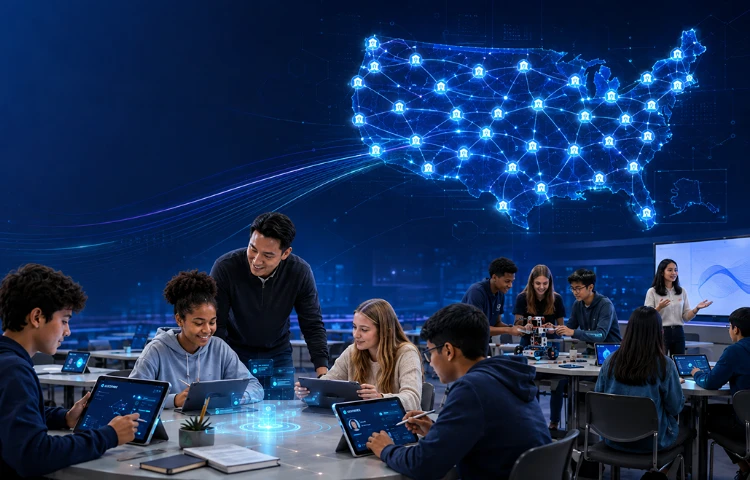
The private K–12 school network plans to grow from approximately a dozen locations to roughly 50 campuses during the 2026 school year. According to [Axios’s report on Alpha School’s expansion] the network is preparing to enter markets including Atlanta, Boston, Charlotte, Chicago, Denver, Nashville and Raleigh. Students at these campuses will spend no more than two hours each day using adaptive educational software for core academic subjects, with the remainder of the day devoted to workshops, projects and practical life skills.
That makes the news that AI-powered Alpha Schools expands to 50 campuses more than another education-industry growth story. It is becoming a large-scale test of whether artificial intelligence can deliver personalized academic instruction while giving students more—not less—time for meaningful human interaction.
What Is Alpha School?
Alpha School is a network of private schools built around what it calls a “two-hour learning” model. Instead of placing every student in front of the same lesson at the same pace, the school uses adaptive learning applications to adjust the content, difficulty and speed of instruction based on an individual student’s progress.
Students complete core subjects such as mathematics, reading, science and social studies during a focused morning block. They move forward after demonstrating mastery rather than simply advancing because a class period or academic term has ended.
The afternoon is reserved for workshops involving communication, entrepreneurship, teamwork, public speaking, leadership and other applied skills.
Alpha’s official expansion announcement states that 27 new campuses are expected to open for the 2026–2027 school year. The announced communities include Kirkland, Park City, Denver, Palo Alto, Chicago, Nashville, Charlotte, Raleigh, Boston, Atlanta, Boca Raton and Miami Beach. The [official Alpha School expansion release] describes this as one of the network’s largest expansions to date.
How Does the Two-Hour Learning Model Work?
The model is based on a straightforward idea: much of a conventional school day is not spent actively learning.
Classroom instruction must normally accommodate a wide range of abilities. Some students may already understand the material, while others need additional explanations or practice. Teachers also lose instructional time to attendance, transitions, classroom management, grading and administrative work.
Alpha attempts to remove these inefficiencies through four main mechanisms.
Personalized pacing
Adaptive applications continuously evaluate a student’s performance. A learner who has mastered a concept can move ahead, while a learner who is struggling can receive additional explanations and practice.
This approach is intended to prevent advanced students from becoming bored and struggling students from being pushed forward before they understand foundational material.
Mastery-based progression
Students advance according to demonstrated knowledge rather than “seat time.” The objective is not to finish a lesson because the schedule says it is over, but to confirm that the student understands the concept.
Immediate feedback
AI-powered learning systems can identify errors as students work. Instead of waiting days for an assignment to be graded, a student may receive feedback immediately and correct a misunderstanding while the problem is still fresh.
Motivation and coaching
Alpha uses adult “Guides” rather than positioning traditional teachers as the primary deliverers of academic lectures. These Guides coach students, monitor motivation, build relationships and facilitate life-skills activities.
Alpha argues that it has not removed adults from education—it has changed their role. In its explanation of [how Guides and AI work together] the organization says academic delivery happens through adaptive applications while Guides focus on emotional support, motivation, mentoring and personal development. Alpha states that every student receives a weekly one-on-one meeting with a Guide.
What Does Research Say About AI Tutoring?
There is legitimate evidence supporting well-designed intelligent tutoring systems. Personalized systems can provide targeted practice, immediate feedback and explanations tailored to a student’s needs.
However, not every chatbot is an effective tutor.
A [Brookings review of generative AI tutoring research] found promising evidence of learning gains, improved engagement, greater knowledge transfer and increased instructional efficiency. The analysis also emphasized that results depend heavily on pedagogical design, accurate feedback, appropriate safeguards and collaboration between humans and AI.
This distinction is critical. An AI system that gives students instant answers may reduce productive struggle and weaken critical thinking. A properly designed tutor, by contrast, can ask guiding questions, provide hints, break complex problems into manageable steps and encourage learners to explain their reasoning.
The technology should teach students how to think—not simply complete the thinking for them.
AI Should Create More Human Learning, Not Less
The most intriguing part of Alpha’s model may be what happens after the laptops close.
Alpha says students spend the majority of their day away from academic software, participating in workshops involving leadership, public speaking, entrepreneurship, collaboration and creative problem-solving. In theory, the AI does what software does well—tracking progress, adjusting difficulty and providing repetitive practice—while humans concentrate on relationships, motivation and social development.
This is an important counterpoint to the assumption that an AI-powered school must involve children staring at screens all day.
The real opportunity is not to maximize screen time. It is to automate or accelerate selected forms of instruction so that students have more time to debate, design, build, perform, collaborate and connect.
That principle should guide AI adoption across education: use technology to create additional capacity for human learning rather than allowing it to replace the human experience.
The Accessibility and Equity Challenge
Alpha’s expansion also raises a difficult question: who gets access to the future of education?
Axios reports annual tuition ranging from approximately $45,000 to $75,000 at Alpha locations. At those prices, the full school model remains available primarily to affluent families.
That does not make the experiment irrelevant. Premium technologies often appear in expensive settings before becoming more widely available. Alpha may help prove—or disprove—certain ideas about personalized learning, mastery-based progression and AI-assisted tutoring.
However, the education sector should not assume that a successful private-school model can simply be copied into every public school.
Public systems must consider device access, internet connectivity, special education, multilingual learners, teacher training, procurement limitations and community expectations. They also serve far more diverse student populations.
The larger goal should therefore be to identify which parts of the Alpha model can improve education affordably and equitably. AI tutoring may eventually help understaffed schools provide more individualized support, but only when the necessary infrastructure, training, privacy protections and human supervision are in place.
What Educators and Technology Leaders Should Watch
As the new campuses open, decision-makers should look beyond headlines and track measurable outcomes.
Important indicators include academic growth, student well-being, attendance, motivation, staff turnover, parent satisfaction, screen time and performance across different demographic groups. Leaders should also examine how often Guides must override the software, how errors are identified and whether students retain knowledge after completing adaptive lessons.
Technology teams developing educational AI should take several lessons from Alpha’s expansion:
- Personalization must be tied to learning science. Adjusting content is not enough unless the system promotes genuine understanding.
- Human oversight must be designed into the model. It cannot be added as an afterthought.
- Privacy and security are core product features. Children’s educational data requires particularly careful protection.
- AI should support active learning. The best outcome is not a faster worksheet; it is more time for discussion, creativity and real-world problem-solving.
- Claims require independent evidence. Educational innovation affects children’s development and deserves a higher standard than marketing metrics alone.
A School Expansion—and a National Experiment
The fact that AI-powered Alpha Schools expands to 50 campuses signals that AI in education is entering a new stage.
The conversation is shifting from “Should students be allowed to use AI?” to “What should an education system designed around AI actually look like?”
Alpha School’s answer is bold: compress core academics into two personalized hours, redesign educators as coaches and dedicate the rest of the day to practical human skills.
It is an appealing vision. Students receive individualized support without being confined to screens for an entire day. Adults spend less time lecturing and grading and more time motivating, mentoring and building relationships. Afternoons focus on skills that will remain valuable in an increasingly automated world.
But bold ideas require careful evaluation. Alpha’s growth should be followed with both curiosity and healthy skepticism. The most valuable outcome may not be proving that every school should operate like Alpha. It may be identifying which elements genuinely improve learning, which require stronger safeguards and which only work under specific conditions.
The future of education will probably not be purely human or purely automated. It will depend on how intelligently we combine the strengths of both.