Artificial intelligence has spent the last few years getting remarkably good at living inside computers. It can write code, analyze documents, search databases, operate software and increasingly complete multi-step digital tasks with limited supervision.
Anthropic now wants AI agents to reach beyond the screen.
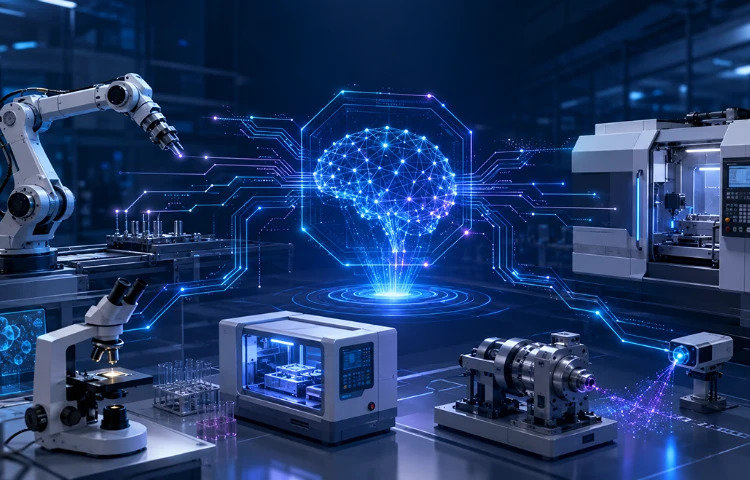
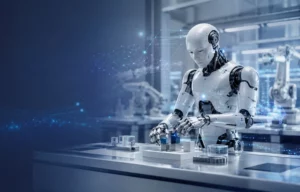
Anthropic unveiled the Model Hardware Standard (MHS), a new framework designed to let AI agents communicate with and operate programmable physical equipment. The early research preview targets scientific laboratories and advanced manufacturing environments, where an AI agent could potentially coordinate microscopes, liquid-handling systems, robotic arms and other instruments as part of one autonomous workflow.
That may sound like a small change in plumbing. It is not.
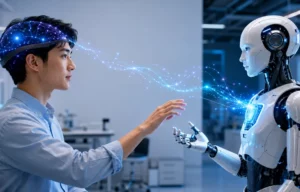
The Anthropic Model Hardware Standard could represent an important bridge between agentic AI and physical AI—turning models that can reason about a task into systems capable of initiating actions in laboratories, factories and other instrument-heavy environments.
Anthropic describes MHS in its [ANTHTROPIC] as a shared specification for safely connecting AI agents with physical devices. [Reuters] similarly notes that the framework is initially being tested with selected partners before a planned open-source release.
What Is Anthropic’s Model Hardware Standard?
The easiest way to understand MHS is to think about the integration problem facing modern laboratories and manufacturing facilities.
A laboratory may contain instruments from several manufacturers, each with its own software, commands, APIs and communication methods. Connecting those devices into one automated workflow often requires specialized engineering and custom integrations.
Anthropic says those integrations can take weeks or even months. MHS is designed to reduce some of that work to hours or minutes by creating a more standardized way for software agents to understand what a device can do and communicate with it.
It is essentially an interoperability layer.
Instead of building a completely different AI integration for every microscope, robotic arm or liquid-handling machine, developers could potentially expose a standardized collection of capabilities that an agent can discover and use.
This matters because the future of physical AI will not be built around one magical robot doing everything. It will likely involve dozens—or thousands—of specialized machines coordinating with intelligent software.
AI Agents Could Coordinate Multiple Physical Devices at Once
One of the more significant features of MHS is that it is not simply about making Claude press a button on a machine.
Anthropic says AI agents can use the framework to operate multiple instruments in parallel.
Consider a research workflow involving a liquid handler, microscope, imaging system and robotic arm. Traditionally, scientists may need separate software platforms, custom scripts and manual intervention to move samples and data between stages.
With an agentic system, the workflow could become more dynamic.
An AI agent could reason through an experimental procedure, instruct one machine to perform a task, inspect the resulting data, modify parameters and then trigger the next instrument.
Anthropic says possible applications range from routine drug-discovery experiments to the calibration of lasers used in quantum computing.[WIRED] explains how the standard is intended to connect AI agents with equipment ranging from microscopes and liquid handlers to quantum hardware and robotic systems.
This is where agentic AI becomes considerably more interesting.
A chatbot answers a question.
An AI agent decides which tools it needs to answer the question.
A physical AI agent could potentially decide which machines it needs, operate them, analyze what happened and determine the next action.
That is a much bigger leap.
Autonomous Laboratories Could Run Around the Clock
Another major promise behind the Anthropic Model Hardware Standard is the possibility of more autonomous experimentation.
Anthropic says MHS could help researchers build round-the-clock experimental workflows in which AI agents reason through stages of an experiment, change settings based on results and, in some circumstances, recover from hardware problems without requiring immediate human intervention.
The attraction is easy to understand.
Scientific equipment is expensive. Many instruments spend significant amounts of time waiting for operators, scheduled processes or downstream analysis. If intelligently automated systems can safely keep experiments progressing overnight or across weekends, organizations could potentially increase equipment utilization while reducing repetitive manual work.
The broader scientific community is already exploring this direction. Research published in Communications Materials, for example, has examined multi-agent approaches to managing autonomous materials laboratories, while other work is exploring self-correcting AI architectures for automated experimentation.
MHS Is Model-Agnostic—and That May Be Its Most Strategic Feature
You might reasonably assume that something created by Anthropic would be designed exclusively for Claude.
Surprisingly, MHS is intended to be model-agnostic.
Anthropic says the standard can work with different AI models and agent frameworks rather than locking organizations into Claude. [report on Anthropic’s first major move into physical AI] notes that this approach is intended in part to reduce vendor lock-in for scientists and engineers.
That decision could be extremely important.
Standards become much more valuable when multiple vendors can adopt them.
The web benefited from open protocols. USB simplified hardware connections. APIs transformed software integration. Anthropic’s earlier Model Context Protocol (MCP) has pursued a similar concept for connecting AI models with software tools and data sources.
MHS appears to extend that thinking toward hardware.
In fact, Anthropic says agent systems can access MHS through standard protocols such as MCP.
So the emerging architecture starts to look something like this:
An AI model provides reasoning.
An agent framework manages goals and actions.
MCP connects the agent to software, services and information.
MHS connects the agent to programmable physical devices.
If that ecosystem gains adoption, developers could build AI agents capable of navigating both the digital and physical parts of a workflow without creating bespoke integrations for every individual tool.
Manufacturing Could Be Just as Important as Scientific Research
Although laboratories provide some of the most eye-catching examples, manufacturing may ultimately become one of the largest commercial opportunities.
Modern factories already contain extensive automation. The problem is that much of it remains highly specialized.
Traditional industrial automation works beautifully when conditions are predictable: move this component from Point A to Point B, tighten this bolt to a predetermined setting, inspect this component using a predefined rule.
AI agents potentially introduce greater flexibility.
An agent might interpret production data, inspect the status of several machines, identify a bottleneck and coordinate equipment differently based on changing conditions.
Anthropic already signaled its interest in this area before launching MHS. In July 2026, the company announced work with UST to bring Claude into engineering environments spanning semiconductors, automotive systems, manufacturing and connected devices.
Anthropic Is Not Alone in the Physical AI Race
Anthropic’s announcement arrives during a broader industry push toward physical AI.
NVIDIA has been building an extensive ecosystem involving robotics foundation models, simulation, edge computing and autonomous-system development. Its [Physical AI research and agent-skills announcement] highlights how developers are increasingly combining simulation, synthetic data, robot policies and autonomous agents into complete physical-AI workflows.
Google DeepMind is moving in a similar direction. Its [Gemini Robotics 2 announcement] focuses on models capable of whole-body robotic control, dexterity and cooperation between machines.
The approaches are different.
NVIDIA is building much of the computing, simulation and robotics infrastructure.
Google DeepMind is developing models specifically designed to reason about and control robots.
Anthropic’s MHS focuses on interoperability—helping intelligent agents communicate consistently with physical equipment.
Those strategies could eventually complement one another rather than compete directly.
A future factory could theoretically contain hardware powered by NVIDIA edge systems, robots using specialized embodied-AI models and higher-level agents communicating with equipment through standards such as MHS.
Physical AI is starting to look less like a single product category and more like an entire technology stack.
Why the Model Hardware Standard Matters for Businesses
For technology leaders, MHS is worth watching even if your company does not own a microscope or robotic arm.
Standards often matter before the applications built on them become obvious.
If MHS or a similar framework becomes widely adopted, organizations may eventually be able to connect AI agents with physical infrastructure using reusable integrations rather than building automation systems from scratch.
That could lower development costs and speed up experimentation across industries including manufacturing, biotechnology, semiconductor production, logistics, electronics and advanced research.
Businesses exploring this area should therefore watch three things closely: how many hardware manufacturers implement MHS-compatible interfaces, whether competing AI providers support the standard, and what safety requirements emerge from the research preview.
Adoption will determine whether MHS becomes foundational infrastructure or simply another interesting protocol in an already crowded AI ecosystem.
Conclusion
Anthropic’s Model Hardware Standard shows where AI is heading next: from working only on screens to helping control real-world machines and equipment.
By giving AI agents a common way to communicate with physical devices, MHS could make it easier to automate laboratories, manufacturing systems, robotics, and other technical environments. Instead of building a separate connection for every machine, companies may eventually be able to use one standard to connect AI with many different types of hardware.
At the same time, safety will be extremely important. When AI starts controlling physical equipment, businesses need clear rules, human oversight, permissions, monitoring, and emergency controls.
MHS is still in an early stage, but the idea behind it is important. AI is becoming more than a tool that gives answers—it is becoming a system that can take actions in the real world.