


Prefer to listen instead? Here’s the podcast version of this article.
Artificial intelligence has transformed how humans communicate, work, and interact with technology. But what happens when AI starts connecting computers directly to the human brain?
NVIDIA, a global leader in accelerated computing and artificial intelligence, is expanding its influence into brain-computer interfaces (BCIs), an emerging field that could fundamentally reshape healthcare, accessibility, and human-computer interaction.
Neurotechnology company Paradromics announced a technical collaboration with NVIDIA to advance the computing infrastructure behind brain-computer interfaces. The initiative aims to improve neural signal processing, restore communication capabilities, and support the development of more portable assistive technologies.
As highlighted in [WIRED] NVIDIA’s computing technology could help address one of neurotechnology’s biggest challenges: translating complex brain activity into meaningful digital actions without relying on bulky external computing systems.
This development represents more than another milestone in artificial intelligence. It signals a future where AI could help restore independence, improve accessibility, and redefine the relationship between humans and machines.
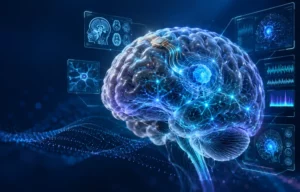
Brain-computer interfaces are technologies designed to establish a communication pathway between the brain and an external computing device.
Rather than relying exclusively on keyboards, touchscreens, or voice commands, BCIs capture patterns of neural activity and translate them into digital instructions through specialized algorithms.
The process generally involves four stages:
Artificial intelligence plays a crucial role because neural signals are complex, highly individualized, and can change over time. Machine learning enables systems to adapt to these variations and improve their interpretation of intended actions.
However, BCIs are not unrestricted mind-reading devices. Their capabilities depend on the signals collected, the models trained, and the specific tasks they are designed to perform.
NVIDIA’s collaboration with Paradromics represents an important step toward making implantable brain-computer interfaces more practical for everyday life.
According to [Paradromics] the companies are working to advance computing systems that support speech restoration, adaptive neural decoding, and additional clinical applications.
For individuals living with severe paralysis or neurological conditions that affect speech, traditional communication methods can be physically demanding or limited in speed.
AI-powered brain-computer interfaces could provide an alternative by interpreting neural patterns associated with attempted speech and converting them into digital text or synthesized audio.
NVIDIA’s contribution focuses on the computational infrastructure behind this process rather than manufacturing the brain implants themselves.
The collaboration could support several important advancements:
Although these technologies remain under development and require clinical validation, their potential to improve communication and independence is significant.
For patients, the ultimate breakthrough is not simply faster computing. It is the possibility of participating more naturally in conversations with family members, caregivers, and the wider community.
One of the biggest obstacles in developing brain-computer interfaces is the enormous computational workload associated with processing neural activity.
Traditional computing architectures can introduce delays, consume significant energy, and require external infrastructure that limits mobility.
NVIDIA aims to address these challenges through its Holoscan platform and Jetson edge computing technology.
Holoscan supports accelerated sensor-data processing and AI inference, while Jetson provides compact computing capabilities that can bring AI processing closer to the individual using a device.
As explained in [NVIDIA] compact, energy-efficient AI computing has already demonstrated research potential in neurological applications.
By processing neural information locally rather than relying entirely on remote cloud infrastructure, edge AI could offer several advantages:
Imagine a future in which an individual can use a speech-restoration system through a compact computing device attached to their wheelchair rather than remaining near a large workstation.
That is the kind of practical improvement edge AI could help make possible, provided that safety, reliability, and clinical performance requirements are met.
While NVIDIA-powered brain-computer interfaces offer exciting possibilities, they also introduce significant ethical and regulatory questions.
Neural information is exceptionally sensitive. Depending on the technology and its capabilities, it may provide insights into an individual’s neurological condition, intended actions, or other personal characteristics.
As neurotechnology advances, organizations must establish safeguards that protect individual autonomy, privacy, and informed consent.
UNESCO adopted an international recommendation addressing the responsible development and application of neurotechnology. Its article [UNESCO] highlights the importance of human rights and ethical safeguards as these technologies become increasingly sophisticated.
Key considerations include:
Local AI processing may help reduce some privacy risks, but it does not automatically guarantee data security or responsible governance.
Businesses developing AI-powered healthcare technologies must integrate ethical considerations throughout the product development lifecycle rather than treating them as an afterthought.
NVIDIA’s growing involvement in brain-computer interfaces demonstrates that the next wave of artificial intelligence innovation may extend far beyond chatbots, generative AI, and enterprise automation.
Healthcare providers, medical device manufacturers, software developers, and technology companies could find emerging opportunities in areas such as personalized assistive software, neurological rehabilitation, real-time medical data processing, accessible digital platforms, and intelligent healthcare infrastructure.
However, commercial success will depend on more than computational performance. Organizations must also address interoperability, affordability, clinical evidence, patient safety, regulatory compliance, and long-term device support.
The most successful innovations will likely be those that combine advanced AI capabilities with measurable improvements in people’s quality of life.
NVIDIA’s expansion into brain-computer interfaces marks a compelling intersection of artificial intelligence, neuroscience, healthcare, and accelerated computing.
Through collaborations with companies such as Paradromics and Synchron, NVIDIA is helping address the computational challenges that have historically limited the practicality of neurotechnology.
From speech restoration and assistive communication to personalized AI models and accessible digital environments, these developments could fundamentally improve how individuals interact with technology.
Nevertheless, the future of brain-computer interfaces must be guided by responsible innovation, strong privacy protections, clinical evidence, and a commitment to equitable access.
The next major breakthrough in artificial intelligence may not be about making machines think more like humans. It may be about helping humans communicate, connect, and live more independently.









WEBINAR
