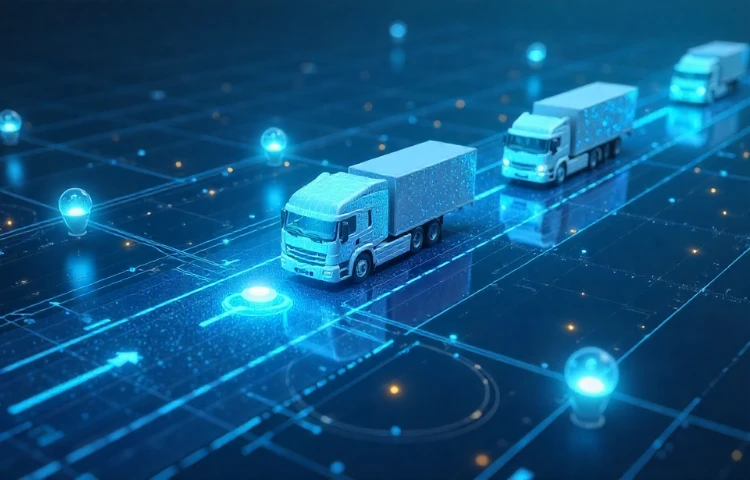
The world of supply‑chain management just got a major AI upgrade. Fujitsu announced the creation of a multi‑AI agent collaboration technology designed to allow AI agents from different companies to coordinate securely — revolutionizing how supply chains respond to disruptions, demand swings, and operational complexity. The company plans to launch practical field trials with Rohto Pharmaceutical Co., Ltd. and Institute of Science Tokyo (Science Tokyo) starting January 2026.
In this post, we dive into what this technology is, why it matters, and what supply‑chain leaders should watch out for — especially if you’re eyeing resilient, intelligent logistics for 2026 and beyond.
What is this multi‑AI agent collaboration technology?
At the heart of Fujitsu’s announcement are two technical innovations, each addressing a core challenge in AI-based supply‑chain coordination. [Fujitsu]
• Global optimal control under incomplete information
Traditionally, coordinating across companies requires sharing sensitive or proprietary data — a big no‑no in competitive supply‑chain networks. Fujitsu’s approach avoids that by enabling a “negotiation-based” collaboration: one AI agent proposes a strategy based on approximated characteristics of other agents (exchanged via suggestion‑answer dialogues), then estimates which overall configuration optimizes the entire supply chain. This means even with imperfect information, AI agents can converge toward globally optimal decisions.
• Secure inter-agent gateway via knowledge distillation & guardrails
To protect corporate confidentiality, Fujitsu introduced a “secure inter‑agent gateway.” This gateway uses distributed learning, knowledge distillation (transferring insights from “teacher” models to “student” models without revealing raw data), and robust guardrails derived from its LLM‑safety knowhow. Before deployment, the system simulates interactions between agents repeatedly, screening out potentially malicious queries and preventing inference of sensitive data.
This means companies can collaborate via AI without sacrificing privacy — a long‑standing barrier in multi‑company AI collaboration.
The trial: What Fujitsu aims to prove
Fujitsu — together with Science Tokyo and Rohto Pharmaceutical — tested the system on a virtual supply chain to optimize logistics routes and schedules. Impressively, the simulation showed a potential 30% reduction in transportation costs.
Beginning January 2026, they will proceed to large‑scale, real‑world trials using Rohto’s actual supply chain (running through March 2027). This will test the resilience of the system in real supply‑chain conditions: variations in demand, logistical constraints, and unexpected disruptions.
If successful, Fujitsu intends to roll this out under its broader business model — Uvance — offering “Dynamic Supply Chain” services by the end of fiscal 2026.
Why this matters: Supply‑chain transformation in a volatile world
• Responsiveness & resilience in real time
In a world where supply‑chain disruptions come in waves — natural disasters, sudden demand surges, geopolitical shifts — static planning and legacy systems often fail. Multi‑agent AI enables real-time decision making: AI agents can recalibrate logistics, reassign suppliers, adjust inventory, or reroute shipments instantly. This moves supply‑chain management from reactive to proactive.
As one external analysis puts it: “Agentic AI can continuously monitor supply, logistics, and market signals and then autonomously simulate and recommend the best response.”
• Privacy‑aware collaboration across organizations
One of the biggest obstacles to cross‑company supply‑chain collaboration is data privacy: no company wants to reveal proprietary info. Fujitsu’s secure gateway solves this — enabling collaboration without raw data sharing. That’s a game-changer for industries where multiple players (suppliers, manufacturers, distributors) must coordinate closely but maintain privacy.
• Cost reduction + sustainability gains
Initial results show up to 30% transportation‑cost savings. Beyond cost, more efficient routing and demand‑driven logistics can reduce waste, carbon footprint, and excess inventory — aligning well with sustainability goals. Fujitsu itself frames this under the United Nations’ Sustainable Development Goals (SDGs), reinforcing its broader mission to “make the world more sustainable by building trust in society through innovation.”
• Lower barrier to AI adoption across industries
Another advantage: through its broader AI‑agent platform (described as its “Multi‑AI Agent Framework”), Fujitsu lowers the barrier for companies with limited AI expertise to leverage complex agent-based workflows.
This democratizes advanced AI, allowing smaller or less‑digitally mature firms to benefit — not just large, tech-savvy enterprises.
Bigger picture: Where this fits in the evolving AI supply‑chain landscape
This development from Fujitsu reflects a broader shift: from single AI models to agentic, multi‑agent, orchestrated AI systems — what some analysts call “agentic AI.”
It also builds on Fujitsu’s previous work: earlier in 2024, the company introduced a multi‑AI agent security system that coordinated different agents (defense, detection, continuity) to protect against cyberattacks.
Additionally, Fujitsu’s expanded collaboration with NVIDIA (announced earlier in 2025) demonstrates that the company aims to integrate high-performance computing, GPU acceleration, and multi‑agent orchestration — creating a foundation for scalable, industry‑specific AI deployments beyond supply chains (e.g., manufacturing, robotics, healthcare).
In other words: this isn’t just supply‑chain AI. It could be the blueprint for how multi‑agent AI transforms entire industries.
Conclusion
Fujitsu’s multi‑AI agent collaboration technology could mark a turning point in supply‑chain management: one where companies collaborate through AI — swiftly, securely, and intelligently — without exposing sensitive data. If the upcoming field trials deliver as promised, we may be witnessing the emergence of a new era of resilient, cost‑efficient, and sustainable supply‑chain networks, powered by intelligent, cooperating AI agents.
Supply‑chain leaders should pay close attention: the future of logistics may not just be smarter — it may be agentic.