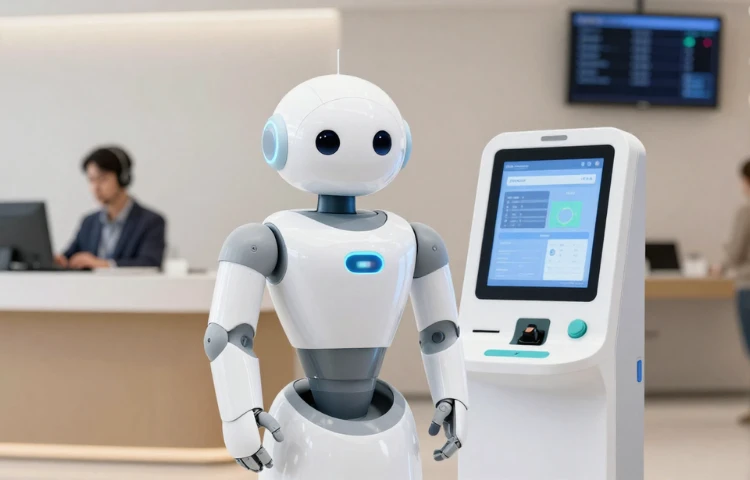
Physical AI is the moment when AI stops living only on screens and starts showing up in the real world as helpful machines: service robots, smart kiosks, sensor driven assistants, and automated back of house helpers. And yes, this is where the ROI math in customer service starts getting spicy.
A recent industry write up on how physical AI adoption boosts customer service ROI highlights the core shift: blending digital intelligence with real world interaction can unlock measurable gains in speed, consistency, and customer experience at the frontline. [AI News]
What physical AI actually means in customer service
Physical AI is not a chatbot with wheels. It is a system that can perceive the environment through sensors, decide using AI models, and act through a physical interface like a robot, kiosk, or automated device. That definition is echoed in enterprise thinking about physical AI as an emerging platform for machines that can handle complex tasks.
In customer service, physical AI typically shows up in three forms:
- Frontline service robots for greeting, wayfinding, and simple requests
- Smart kiosks for check in, ticketing, returns, and account updates
- Behind the scenes automation like inventory runners or delivery bots that reduce service delays
Why Physical AI adoption boosts customer service ROI
Customer service ROI usually comes down to a handful of levers: cost to serve, capacity, resolution speed, and customer satisfaction. Physical AI touches all four.
1. Faster service and higher throughput
When a robot or kiosk handles repetitive requests, your human team gets capacity back for high value conversations. That hybrid model of people plus agents plus robots is exactly where productivity gains tend to compound over time.
2. More consistent service quality
Humans vary. Machines are predictable. That is a feature in high volume environments like retail, airports, clinics, and hospitality where customers want quick, accurate answers. Research on service robot interactions points to the importance of perceived value and relationship quality in driving better experiences.
3. Better customer experience without hiring spikes
Seasonal surges are brutal: wait times climb, burnout rises, and customer sentiment drops. Physical AI can absorb peaks with steadier performance. In hospitality settings, studies have explored customer satisfaction and adaptation behaviors around service robots, showing how acceptance and experience depend on how the robots are deployed and supported.
4. The data flywheel that keeps improving ROI
Robots generate operational data constantly: task durations, failure points, customer flow, repeat questions, and edge cases. Over time, this creates a feedback loop where autonomy improves, human intervention drops, and ROI rises.
A practical playbook to capture ROI without making it weird
Physical AI succeeds when it feels like a smooth service upgrade, not a gimmick. Here is a rollout approach that works in the real world.
Pick high frequency low complexity tasks first
Start with tasks that are easy to standardize and easy to measure: wayfinding, FAQs, queue triage, basic check in, order status, returns initiation, appointment confirmations.
If you are already investing in autonomous digital workflows, connect that foundation to frontline execution. This internal overview on autonomous AI in enterprise operations is a useful bridge for thinking end to end about AI driven execution.
Design for the handoff, not the robot
The best customer experience is: machine handles the routine, humans handle the nuanced, and the handoff is instant and graceful. This is also where customer trust is won or lost.
If you are building systems that affect real people in real spaces, governance is not optional. This internal primer on governance platforms lays out why the market is moving toward stronger accountability.
Put safety, privacy, and transparency on day one
Physical AI often uses cameras, microphones, or proximity sensors. That means privacy and disclosure need to be baked in: signage, clear policies, minimal data retention, and tight access controls.
For broader context on why trust and governance are now central to adoption, this internal discussion on ethics and execution is a helpful compass.
Conclusion
Physical AI is quickly becoming a practical way to turn customer service from a cost center into a measurable growth lever. When you deploy it in the right moments, high volume, repeatable tasks, clear queue management, and simple requests, you reduce wait times, improve consistency, and free human agents to focus on the interactions that actually require empathy and judgment. That mix is where ROI accelerates: lower cost to serve, higher throughput, stronger satisfaction scores, and cleaner operational data that keeps optimizing performance over time.
The smartest path forward is disciplined and customer first: start small with use cases you can track, design seamless handoffs to humans, and build privacy, transparency, and governance into the rollout from day one. Do that, and physical AI does not feel like a novelty, it feels like better service: faster, smoother, and available when customers need it most.