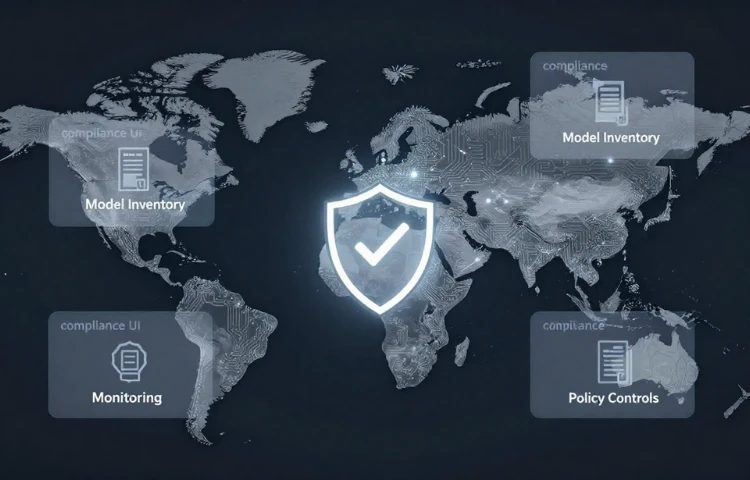
Global AI regulation is no longer a future concern—it’s a present-day operational reality. From the EU’s risk-based AI Act to emerging standards like ISO/IEC 42001 and expanding national guidance worldwide, organizations are being asked to demonstrate not just that their AI works, but that it is safe, transparent, fair, and accountable across its entire lifecycle. As these rules proliferate and diverge across regions, compliance is shifting from a legal checkbox to an ongoing, evidence-driven discipline—one that requires consistent documentation, monitoring, and oversight.
This is where AI governance platforms are stepping in. Built to unify policies, risk controls, model inventories, testing evidence, and audit-ready reporting, these platforms are rapidly becoming essential infrastructure for enterprises deploying AI at scale. In this article, we’ll break down what’s driving the billion-dollar market surge, what capabilities matter most, and how teams can use governance tooling to turn regulatory pressure into a competitive advantage.
Why global AI regulation is exploding
Regulators are converging on a simple idea: risk-based oversight. Different jurisdictions use different language, but the pattern is similar:
- Classify AI by risk
- Require documented controls for higher-risk uses
- Enforce transparency and accountability
- Penalize non-compliance
The EU AI Act is the clearest example of this risk-based model, setting obligations that increase with the potential harm of the system. A major operational requirement inside that approach is a continuous risk management system across the AI lifecycle for high-risk systems, not a one-time checklist.
At the same time, standards are stepping in to operationalize “responsible AI” in a way auditors and customers can actually evaluate. ISO and others are making governance measurable, repeatable, and certifiable. ISO IEC 42001, for example, specifies requirements for an AI management system that organizations can implement and continually improve.
Why this creates a billion-dollar opportunity for governance platforms
Here’s the punchline: compliance is becoming a data problem.
To comply, organizations need to answer questions like:
- Where is AI used across the business
- What data is it trained on and who approved it
- Which models are high-risk and why
- How bias, privacy, safety, and robustness were tested
- How the model behaves after deployment
- What changed since the last review
Doing that in spreadsheets is like trying to run an airport with sticky notes.
That is why AI governance platforms are booming. They centralize the work into repeatable workflows: inventories, approvals, risk scoring, documentation, monitoring, incident response, and audit trails.
Gartner’s framing is basically: the cost of unmanaged AI risk is rising, regulation is fragmenting, and enterprises will pay for tooling that turns chaos into evidence. [Gartner]
What “AI governance platforms” actually do
Think of a governance platform as the connective tissue between legal, compliance, security, data science, and product. The most valuable platforms typically cover:
1. AI system inventory and classification
A living registry of models, vendors, data sources, use cases, and risk tiering. This maps directly to risk-based regulation expectations in places like the EU.
2. Policy and controls, baked into workflows
Instead of “guidelines” living in a PDF, governance becomes automated gates: required documentation, approvals, testing evidence, and sign-off.
3. Testing and measurement
Bias, robustness, privacy, explainability, and performance testing are tracked, versioned, and tied to governance decisions.
4. Production monitoring and incident response
Models drift. Data shifts. Prompts get weird. Governance platforms create alerts, monitoring dashboards, and repeatable response playbooks. This is especially important for reliability issues in generative AI.
5. Audit-ready reporting
When regulators or customers ask “prove it,” the platform produces the trail: what you did, when you did it, and who approved it.
The strategic shift: governance as a growth enabler, not just compliance
The best organizations are not treating governance as a speed bump. They are treating it as a trust engine:
- Faster procurement approvals because risk reviews are standardized
- Quicker launches because documentation is created along the way
- Stronger enterprise sales because customers want proof
- Lower operational risk because monitoring is continuous
This aligns closely with the practical guidance in the NIST AI Risk Management Framework, which breaks responsible AI into repeatable functions like govern, map, measure, and manage.
Practical next steps for teams evaluating AI governance platforms
If you are building your 2026 plan now, start here:
- Create an AI inventory: include third-party AI, embedded AI features, and shadow AI tools.
- Define risk tiers: map to EU-style categories even if you are not in the EU because customers may be.
- Adopt a framework: NIST AI RMF is a strong baseline, ISO 42001 is a strong operational target.
- Operationalize monitoring: governance ends badly when it stops at pre-launch review.
- Buy tools for evidence, not vibes: the winning platforms make compliance artifacts automatic.
Conclusion
AI regulation is moving fast, and the direction is clear: organizations will increasingly be expected to prove how their AI systems are governed, monitored, and controlled—not simply claim that they are responsible. As frameworks mature and enforcement becomes more consistent, the real differentiator will be operational readiness: knowing where AI is used, understanding risk, documenting decisions, and continuously validating performance in the real world.