BMW Group has launched a pilot project using humanoid robots at its Leipzig plant, marking its first deployment of this kind in Europe. The goal is not a flashy demo. It is to integrate humanoid robotics into real series production workflows and test applications in high voltage battery assembly and component manufacturing.
That matters because European manufacturing is not short on automation. What it is short on is flexible automation that can handle messy reality: variant heavy production, constant changeovers, labor constraints, and tasks that are repetitive, ergonomically demanding, or safety sensitive. BMW is explicitly positioning humanoids as a complement to existing automation, not a replacement for everything already bolted to the floor.
Meet AEON: a humanoid designed for factory reality, not sci fi
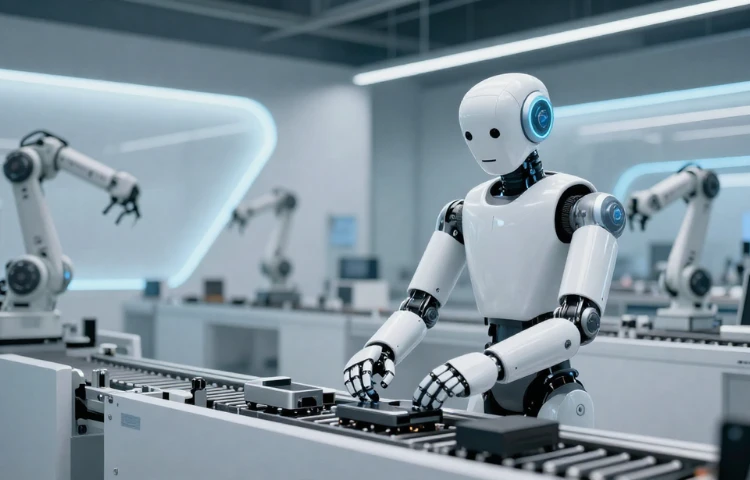
BMW’s Leipzig pilot is being done with Hexagon Robotics and its humanoid robot AEON, first presented in June 2025. BMW describes a structured ramp: evaluation, lab tests, an initial test deployment in Leipzig in December 2025, another test deployment planned from April 2026, and a pilot phase expected to start in summer 2026. [BMW Group PressClub]
One practical detail is easy to miss but very telling: AEON uses wheels for mobility. That design choice is about coverage and efficiency in a large plant environment, while still keeping a humanlike upper body that can use different grippers or scanning tools depending on the task.
Why BMW is doing this now: Physical AI needs three things BMW already has
BMW frames this as Physical AI, meaning AI that does not just analyze dashboards but can perceive, decide, and act through machines in real environments. The not so secret ingredient is data. BMW emphasizes a unified IT and data model across production, moving away from isolated silos toward a standardized data platform that keeps information consistent and available. That is the substrate that makes learning robots and AI agents more deployable at scale.
If you want a deeper primer on why simulation accuracy and digital twins are becoming make or break for real world robotics deployments, this Quantilus piece connects the dots between robotics, hyper realistic simulation, and the sim to real gap.
The real business question: what can a humanoid do that a conventional robot cell cannot
Humanoids are not here to beat industrial robot arms at speed, repeatability, or unit cost in a fixed station. The value proposition is different:
- One body, many tasks: Swap end effectors and tools, then redeploy across stations.
- Human compatible geometry: Reach shelves, handle bins, operate in spaces designed around humans without rebuilding the entire workstation layout. [New Atlas]
- Better coverage for awkward work: The kind of repetitive or ergonomically punishing tasks BMW explicitly calls out as targets for relief.
BMW’s earlier pilot in Spartanburg in the United States helps explain the ambition. BMW reports that a Figure AI robot supported production of more than 30,000 BMW X3 vehicles in about ten months, handling sheet metal parts for welding and moving tens of thousands of components in shift style operation. BMW also highlights a key operational lesson: the transition from lab motion training to production was faster than expected, but only because production IT, safety, process management, and shop floor logistics were involved early.
Why Europe’s factories are watching: compliance and competitiveness collide
Europe has a unique mix of incentives and constraints. Yes, productivity matters. But so do worker safety regimes, product conformity requirements, and a regulatory environment that is increasingly explicit about autonomous and AI enabled machinery. That makes BMW’s Leipzig move a signal to every manufacturer: this is becoming normal, and the winners will be the ones who operationalize safety and governance, not just pilots.
Two regulatory threads matter most:
1. Machinery safety rules are getting sharper for advanced robotics
The European Commission has been explicit that updated machinery rules are meant to address advanced machines such as autonomous machines and collaborative robots.
2. AI compliance is becoming inseparable from machine compliance
If AI is used in safety functions such as perception for collision avoidance or human detection, it can trigger a dual compliance mindset across AI governance and machinery safety requirements. [Bird & Bird]
On the standards side, ISO 10218 1 2025 sets safety requirements for industrial robots, and it is part of the baseline conversation for anyone putting robots near people in industrial settings.
What factory leaders should take from BMW’s pilot: a practical checklist
- Start with tasks that are boring, risky, or physically punishing
BMW explicitly targets monotonous, ergonomically demanding, or safety critical tasks as a sweet spot.
- Treat deployment like an integration project, not a robot purchase
BMW’s Spartanburg learnings emphasize early involvement from safety, IT infrastructure, logistics, and process ownership.
- Make your data usable before you make your robots smart
Unified data models and standardized interfaces reduce friction when you scale beyond a demo cell.
- Build governance into the rollout, not after the first incident
For a wider lens on ethics, trust, and how leading organizations are thinking about responsible adoption, this Quantilus piece is a useful companion read.
Conclusion
Europe’s manufacturing story is entering a new chapter, and the big shift is not just more automation, it is more adaptable automation. What is happening in Leipzig is a real world test of whether Physical AI can handle the messy, fast changing reality of modern production without forcing factories to redesign everything around fixed robot cells. The factories that win will be the ones that treat this as a systems rollout: strong data foundations, smart task selection, safety and compliance baked in from day one, and a clear plan for how humans and machines share the floor.
If you are leading operations, engineering, or digital transformation, the takeaway is simple: start learning now. Identify the repetitive, awkward, or high risk tasks, build a safe pilot environment, and get your IT, safety, and production teams aligned early. Because once flexible automation proves it can deliver reliable uptime and measurable ROI in Europe’s regulatory landscape, this stops being a trend story and becomes the new baseline.