The future of workplace productivity is getting a lot more personal — and a lot more portable. As AI moves beyond chatbots and meeting apps, a new generation of wearable AI devices is emerging to help teams capture what actually happens during the workday. From quick hallway discussions to client meetings and brainstorming sessions, these tools are designed to turn spoken ideas into summaries, action items, and searchable business knowledge.
This shift marks an important moment for modern enterprises. Valuable decisions often happen outside scheduled video calls, where context can easily get lost or forgotten. Wearable AI aims to close that gap by giving teams a smarter way to preserve important details, improve collaboration, and reduce the constant need for manual note-taking. But as exciting as this technology is, it also raises important questions around privacy, consent, and responsible AI adoption in the workplace.
The Next Big AI Interface Might Be Pinned to Your Shirt
Workplace AI has spent the last few years living inside screens: Slack threads, Zoom calls, Google Meet summaries, CRM dashboards, and document copilots. But Vibe’s new device, Vibe Dot, suggests the next frontier is more physical. Instead of waiting for work to happen inside a meeting app, Dot is designed to capture the messy, valuable, real-world conversations that happen in offices, hallways, client visits, brainstorming sessions, and field environments.
According to SiliconANGLE, Vibe Dot captures spoken conversations and voice commands in real time, syncing them with the Vibe AI app so conversations can become structured summaries, institutional memory, and even triggers for connected AI agents. The company says the device is built for enterprise teams rather than the consumer gadget crowd, which makes sense: businesses lose enormous value when decisions are made verbally and never documented. [SiliconANGLE]
What Is Vibe Dot?
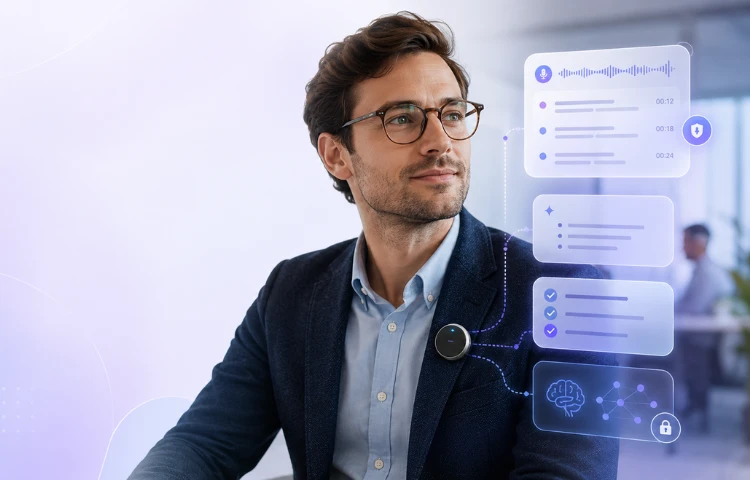
Vibe Dot is a small, round wearable AI device that can attach to a lapel or connect magnetically to the back of a smartphone using MagSafe for iPhones or a magnetic ring for Android devices. The device reportedly includes five microphones, can capture audio from up to 16 feet away, and offers around 30 hours of continuous recording. That combination positions it less like a voice memo recorder and more like a portable meeting intelligence layer for the physical workplace.
The AI Journal describes Dot as a $199 palm-sized AI wearable aimed at professionals who need help capturing and acting on conversations without constantly typing notes or opening apps. That pricing and form factor make it especially interesting for sales teams, consultants, project managers, healthcare administrators, legal professionals, field operations teams, and executives who spend much of their day moving between conversations. [The AI Journal]
Why Real-World Conversation Capture Matters
Here is the uncomfortable truth: many important business decisions still happen outside digital systems. Someone approves a change during a hallway chat. A client mentions a concern during an onsite visit. A manager assigns follow-up work after a workshop. A team debates priorities around a whiteboard. Then everyone walks away with a slightly different memory of what happened. Classic workplace chaos, now with better coffee.
Vibe’s broader platform is built around the idea of a contextual workspace that remembers. Its Vibe AI page frames the problem clearly: teams lose momentum when meetings, documents, and chats remain scattered instead of becoming connected context. Vibe says its system turns conversations, docs, and chats into a “living memory” so teams can avoid repeated recaps and lost decisions.
That idea lines up with a broader enterprise trend Quantilus has already explored in posts like AI Agents in the Workplace: A Game-Changer for Finance and Ops, where agentic systems are described as tools that can reason across systems, execute workflows, and reduce repetitive coordination work. Vibe Dot fits neatly into that shift: it does not just record conversations; it gives AI agents more real-world context to act on.
From Transcription to Action: The Real Value
The most exciting part of Vibe Dot is not transcription alone. Transcription is useful, but the real enterprise value comes when spoken conversations become searchable, structured, and actionable.
A strong workflow might look like this: a product manager discusses a feature change with engineering, Dot captures the conversation, Vibe AI summarizes the decision, extracts action items, links the conversation to existing project context, and sends follow-ups into tools like Jira, Slack, or a CRM. That is where “AI note-taking” becomes “AI operational memory.”
This is also why Dot’s connection to agentic AI matters. SiliconANGLE reports that Vibe Dot can connect voice commands to external agents, including tools such as Claude Code or OpenAI Codex, for voice-triggered task execution. In other words, a spoken instruction could eventually become a real workflow, not just a line in meeting notes.
The Privacy Question: Helpful Assistant or Workplace Surveillance?
Now for the part no responsible AI blog should skip: privacy. A wearable AI device for workplace conversations is powerful precisely because it is always close to the action. But that also means it can capture sensitive, confidential, or personal information if organizations do not set clear rules.
Digital Leaders recently warned that workplace wearables create legal and ethical complexity because AI-enabled devices can record conversations, capture images, livestream, and interact with assistants in ways that may not be obvious to nearby people. Fordham’s privacy blog has also highlighted the tension around AI notetakers in meetings, noting that automated transcription and summaries can improve documentation while creating privacy and risk concerns.
For enterprises, the takeaway is simple: Vibe Dot should not be treated like a casual productivity toy. It should be governed like an enterprise data system. That means consent policies, recording notices, access controls, retention limits, encryption, audit logs, role-based permissions, and clear rules about where the device can and cannot be used.
How Vibe Dot Compares to Meeting Bots and AI Notetakers
Traditional AI meeting assistants usually join calendar-based calls. They work well for Zoom, Teams, and Google Meet, but they miss offline work. Vibe Dot aims to close that gap by capturing conversations that happen outside scheduled digital meetings.
This builds on Vibe’s earlier Vibe Bot, an in-room AI device launched at CES that captures office interactions, organizes decisions and next steps, and connects meeting context to enterprise tools. Business Wire described Vibe Bot as a physical AI teammate that “listens, understands, and remembers,” with features for offline meeting capture, voice-ready assistance, and structured meeting outputs. [Business Wire]
The difference is mobility. Vibe Bot belongs in rooms. Vibe Dot follows people. That makes Dot potentially more useful for professionals whose work happens across locations, but it also raises the stakes for responsible deployment.
What Businesses Should Do Before Adopting Vibe Dot
Before rolling out wearable AI devices, companies should create a practical adoption framework. Start with clear use cases: client meeting summaries, internal workshops, site visits, training sessions, or sales calls. Then define what should never be recorded, such as HR matters, legal privilege discussions, confidential negotiations without consent, or personal employee conversations.
Security teams should evaluate data storage, vendor terms, encryption, admin controls, export options, deletion workflows, and whether recordings or transcripts are used for model training. AudioCodes’ enterprise guide to AI meeting intelligence recommends looking for controls such as RBAC, SSO/SAML, audit trails, retention policies, encryption, and admin policies that prevent unauthorized recording. [AudioCodes]
The Bottom Line
Vibe Dot is more than another AI gadget. It represents a bigger shift toward ambient, context-aware workplace AI—systems that capture what happens in the real world, organize it, and help teams act on it. For businesses drowning in meetings, scattered decisions, and forgotten follow-ups, that is a compelling promise.
But the winning companies will not be the ones that simply hand out AI wearables and hope for productivity magic. They will be the ones that pair tools like Vibe Dot with thoughtful governance, transparent consent, strong cybersecurity, and workflow design that turns captured conversations into measurable business value.
The future of work may not be fully remote, fully in-office, or fully automated. It may be remembered better. And if Vibe Dot succeeds, the humble workplace conversation might finally get the AI upgrade it has been waiting for.