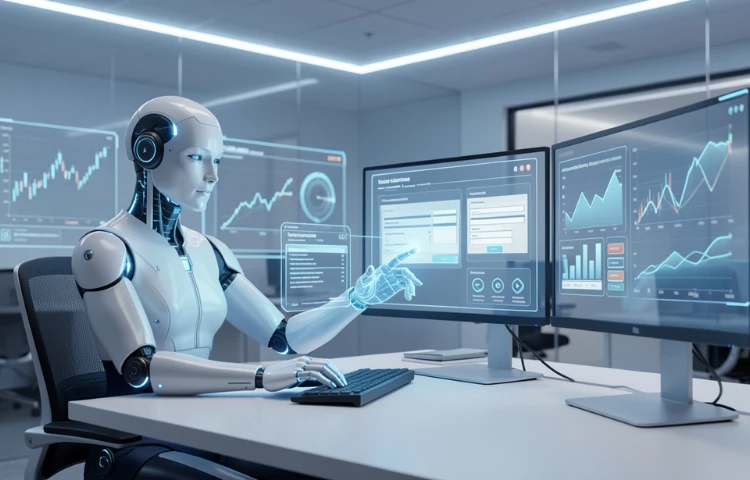
In 2026, the AI revolution in enterprise productivity took a decisive step forward when Goldman Sachs, one of the world’s leading investment banks, began testing autonomous AI agents capable of handling complex, repetitive, and rule‑based internal processes. This move — part of a strategic partnership with AI startup Anthropic — signals a shift from AI as an assistant to AI as a true digital co‑worker. [AI News]
What Are Autonomous AI Agents?
Autonomous AI agents are advanced software systems that can independently manage multi‑step processes, make decisions guided by logic and rules, interact with internal systems, and deliver outcomes without constant human input. Unlike traditional automation scripts or simple AI chat assistants, these agents integrate reasoning, memory, and contextual understanding into workflow execution. [Kasun AI Insights]
These systems enable organizations to tackle work traditionally considered too complex for automation — such as accounting, compliance checks, and client onboarding — by processing vast data sets and applying structured logic. [PYMNTS]
To understand how AI is transforming professional work more broadly, look at this Investopedia overview on AI in finance which provides useful background on AI’s role in banking and financial services.
The Goldman Sachs–Anthropic Partnership
Goldman Sachs has spent roughly six months collaborating with Anthropic engineers to build and refine autonomous agents tailored for its internal processes. These agents are powered by Claude Opus 4.6, an Anthropic AI model designed for reasoning and long‑context tasks — capable of interpreting large documents, navigating rules, and executing multi‑step operations.
According to reports, the focus areas include:
- Trade and transaction accounting
- Compliance workflows including KYC/AML (Know Your Customer / Anti‑Money Laundering)
- Client onboarding and vetting
These are complex, labor‑intensive tasks that until now resisted automation due to regulatory constraints and massive data volumes. [The Economic Times]
Marco Argenti, Goldman’s Chief Information Officer, describes these systems as “digital co‑workers” — not replacements for staff but productivity multipliers that free professionals from repetitive manual work. [The Times of India]
Why This Matters: Inside Enterprise AI Adoption
Goldman’s work embodies a broader enterprise trend: AI moving from draft assistance to executive execution. Traditional AI helped employees draft text or summarize information. Autonomous agents now aim to complete entire workstreams end‑to‑end.
This shift has several important implications:
Efficiency Gains:
Internal tests reportedly showed meaningful improvements in workflow speed — cutting down onboarding time and accelerating compliance checks.
Human‑Machine Collaboration:
Rather than replacing employees, autonomous agents are being positioned as tools that handle repetitive segments of work, allowing human experts to focus on judgement and strategic oversight.
Competitive Pressure on Enterprise Software:
The rise of agentic AI has driven market uncertainty among traditional software vendors, as systems that can autonomously execute tasks could diminish the value proposition of legacy enterprise tools.
AI Reliability and Governance:
Deploying AI in regulated industries demands robust governance — tracking decisions, ensuring compliance, and maintaining human oversight — all of which are central to enterprise deployments. Learn more about the technical side of agent scalability in this article on how logic and search separation improves AI agent reliability.
Looking Ahead: The Future of Work and AI at Scale
Goldman Sachs’ work with autonomous AI agents is a bellwether for how large organizations will redesign internal workflows in the coming years. It reflects a future where:
- AI handles structured, rule‑based tasks
- Humans steer strategic and interpretative decisions
- Hybrid teams of people plus AI raise productivity to new heights
For a deeper look at how AI models are poised to reshape everything from personal agents to global enterprise ecosystems, check out Goldman Sachs’ forward‑looking piece on What to Expect From AI in 2026: Personal Agents, Mega Alliances, and the Gigawatt Ceiling.
Conclusion
Goldman Sachs’ foray into autonomous AI agents represents a transformative moment in the evolution of business intelligence and operations automation. By co‑developing real task‑oriented AI agents with Anthropic, the investment bank is charting a course for productivity that blends human judgment with machine scalability — and the implications extend well beyond finance.